Tuesday, April 21, 2020

The lost poem of John Bonar, sundial maker - Ayr, Bangor and Kirkcudbright

Old original sundial from the Bangor Abbey - Picture of North Down ...

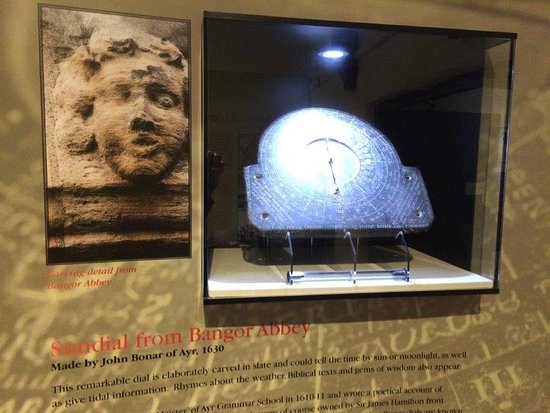
Above is a photo from TripAdvisor of the sundial in North Down Museum which was once at Bangor Abbey. It was made by a famous Scottish sundial maker called John Bonar around 1630. Another of his is at Kenmure Castle, Kircudbright. Here is an intriguing reference to him, and to a (sadly lost) poem that he wrote about a journey from Ayr to Bangor.

"... In a manuscript volume of poems and miscellaneous pieces now in the possession of David Constable, Esq. Advocate, written about the year 1631, the author, John Bonar, schoolmaster. Ayr, gives in verse an account of a voyage from the port of Bangor in Ireland, with a description of some of the objects of natural curiosity and antiquity of the coast of Carrick, from Loch Ryan to Ayr. In this volume the following passage occurs:

The britones marchet, tuo dayes before the feild
To Marrok's mote, for easement and for beild;
Afore the night they waughtet liquor fyne,
Lyke filthie beasts lying like drunken swine.
Quhen fergus heare they wer in sutch a pley,
Doune fra Craigsbian he came right suddenly,
And tooke his will upon his traitrous foes,
Quhair thousands lay skatteret like windlestroes.
Coylus he fledd unto the river Doune,
Quher drownet were many yt thair did runn,
And northward held, quhil they cam till a muir.
And thair wes stayet be Scots that on him fuir.
Fergus he followet and came right heastilie,
Quhair Coyll wes killet and all his hole armie;
The cuntry people fra thenseforthe does it call
Coylsfield in Kyll, as ever more it sall.
Within twelve years, or litle mor's I guess,
A trew story ane ditcher told me these;
Tirring the earth for fewell to his flett,
His spead did run upon ane stane bot lett,
Quhilk, quhen he hade espyet earnestlie,
A tomb it wes buildet full curiouslye;
He roll'd awaye, and fund a pitcher law
With ashes, and bones, that all men might it knaw,
Upon the stone wer graven letters fayre,
Koyl's cij-p of this as now 1 speak no more..."

- From The New Statistical Account of Scotland, 1845

Constable was a noted collector of Scottish literature, the son of Archibald Constable (Wikipedia here). His collection seems to now be in the National Library of Scotland. Maybe one day the Bangor poem will be unearthed.

Monday, April 20, 2020

Betsy Gray, the 1798 Rebellion, and further evidence for the Six Road Ends traditions - draft


I've posted here about 1798 Rebellion heroine Betsy Gray before, and I was very pleased when Professor Guy Beiner made contact with me to ask permission to incorporate some of that information in his 2019 book Forgetful Remembrance; Social Forgetting and Vernacular Historiography of a Rebellion in Ulster (available here). Betsy's birth place / home place has been contested over the years. The strongest likelihood has always been Six Road Ends outside Bangor. I have visited the ruined cottage, which is in the grounds of Summerhill Nursing Home.

Recently I managed to pick up a fairly obscure little 40 page booklet which was published to mark the 200th anniversary in 1998 by Newtownards Historical Society, Upper Ards Historical Society, the North of Ireland Family History Society and Ards Borough Council. It has seven chapters, all of which are strong, but in particular the one entitled 'The Betsy Gray Legend Revisited' by the late Dr Hugh H. Macartney (1926–2015) stands out as particularly important. As a boy in the 1930s he often visited his relatives who lived in the cottage. He wrote that the family traditions of the Grays and Macartneys at Six Road Ends had not been published elsewhere before, but I think that the NIFHS published them simultaneously in their own journal. He also makes the point that the very well respected late Jack McCoy's booklet Ulster's Joan of Arc made some errors. I have taken the liberty of posting the pages below due the the rarity of the booklet, as I am sure the information will be of interest to some of my readers.

Often, these stories are only mined when they are politically useful. For me, enduring community traditions are far more important. What do we choose to remember? What does our community choose to retell, and how is it retold? What does civic society decide that we should know about? We all bring on our journey the baggage we think important. We all have gaps of important stuff which have been left behind.

Betsy and her continuing appeal is a fascinating phenomenon. Perhaps there is a project in that. But 1798 as a whole is a story which needs to be fully told one day.


Sunday, April 19, 2020

Helen Gilliland of Bangor (1897–1942)


Helen Gilliland was a big star in her day, a child prodigy winning singing competitions everywhere in Ulster from the Londonderry Feis in 1910 to big events in the Protestant Hall in Ballymena. Her father John was a well-known official in the Northern Bank who, at the time of his death in 1923, lived at 90 Seacliff Road in Bangor.

Helen was a pupil of Victoria College in Belfast. She hit the big time in 1917 when she signed with the D'Oyly Carte Opera Company and Gilbert & Sullivan; she became the advertising face of various cosmetic and fashion brands, like Ponds and Debenhams, shown in the adverts here. She graced the major stages of London and New York, and socialised with world famous celebrities like Amy Johnson the aviator.


She only appeared in one film, a minor role in The Storm, in 1938, with Charles Bickford in the lead role. The plot line, set onboard a stricken ship caught up in a typhoon, would seem to have been something of a portent.

When World War 2 broke out, Helen was involved in entertaining troops overseas. After a season in India, in early December 1942 she and her husband Norman Eric Peter Franklin were onboard a troop ship carrying 600 people en route to their next destination, in Africa. The ship was torpedoed by the Japanese Navy. The couple ended up in the water together – Franklin was washed back into the sinking ship but when he emerged he was unable to find Helen again. She was never recovered. Her husband spent five days adrift on a life raft before being picked up.

Her death was widely reported in the UK press, with the Daily Record saying that she was "Irish-born but with a strong Scots parental link" and that she had performed in Glasgow.


Thursday, April 16, 2020

"A man o' independent mind" - James Wood (1865-1936)


When you assume that communities are uniform groupthink 'blocs' then you totally miss the diversity within. 'Old dead guys' get a bad press today because apparently the only thing that matters about them any more is their gender. But ideas, beliefs and actions are more interesting than any individual's chromosomes. Plenty of men stood up and stood out in their own day, sometimes to great personal or professional cost. Bright blazing moments of conviction.

The 'Establishment' in every era sets the boundaries of what is acceptable, usually to preserve its own power. This also happens today, where a cosmetic approach to 'diversity' brings together carefully selected groups of people who appear to be different, but broadly think the same. However it's the Dissenters and Non-Conformists within who are always interesting. Here is one who, as Robert Burns said, was "a man o independent mind". 

............................................................

James Wood (1865–1936)
Monaghan-born Presbyterian who broke 'landlordism' control in Unionist politics, standing for "Reform, Sobriety, Equal Rights and Goodwill among men"


Introduction
James Wood was born in Clones in County Monaghan. His parents had been evicted by landlords from a farmstead in County Fermanagh because they refused to vote "Tory". James moved to Belfast as a young man, became an apprentice in a law firm, and settled at a farm called Mount Salem on the Ballyrussell Road in the hills between Comber and Dundonald. There is a property of that name still there today. Land Reform was a key issue of the time and Wood's legal clients included many tenant farmers.

Wood addressed the Ulster Convention in favour of compulsory land purchase at the Ulster Hall on 5 June 1901, as did a fiery Scot with a famous Ulster name – Thomas Russell. Up to 5000 people are said to have attended – "the great mass of the people were Protestant farmers, men with bronzed faces, clear grey eyes, neat but homely dress and the steady, composed air of the countrymen of the North. There was no excitement, no hysterics, but a serious, determined air, such as men wear who know their business and mean to do it", according to the Ballymoney Free Press of 13 June 1901.

The East Down By-Election of 1902
The Fife-born Scotsman Thomas Wallace Russell was the long-standing MP for South Tyrone, a Liberal Unionist and later an Independent Unionist who was elected with strong support from tenant farmers. Wood joined his cause and stood as a 'Russellite' candidate in the 1902 by-election in East Down. The Irish News published a letter from him on 21 January in which he said –

"... I am and always have been a convinced Unionist, but this election will be fought on One Great Issue, that of the Permanent and Final Settlement of the Land Question ... any scheme for the improvement of the agricultural labourer would have my earnest support ... I am a member of the Presbyterian church... I shall ever advocate the just claims of equal treatment of every other denomination ..."
Wood won by 3576 votes to 3429, his cross-community appeal clinching the victory. He and Russell were carried shoulder high to the Down Hunt Arms Hotel in Downpatrick, where the Non-Subscribing Presbyterian minister of Moneyrea, Rev R Lyttle, praised their success. Bonfires were lit across the constituency that night.

Wood and Russell went to Westminster; the Ballymoney Free Press described Russell as "the lion of the land of Ulster" on 13 March 1902, and quoted him as saying –

"... I believe that all through Ulster there will be an understanding on these lines ... that the Nationalist and Unionist, Catholic and Protestant, will go to the polls and make an end of that land system which has cursed all alike... I am the grandson of an evicted tenant – a man who left his all upon a Scotch farm and went out upon the world penniless and ruined. My father was silent. The grandson has broken out. I have hated Irish landlordism since the day I first understood it ... I am for the Union fixed and irrevocably – I am not for the vested villainies which shelter themselves behind it. Against these I shall maintain constant war ..."
1903: North Fermanagh and James Craig's entry into politics
In the following year of 1903 another election opportunity arose, in North Fermanagh. There was local cross-community pressure to select Sir Horace Curzon Plunkett as the Unionist candidate, but Russell was dead-set against him – "Plunkett was a man of family; Russell was a peasant". So the 'Russellites' put forward their own rival candidate, the well-known Fermanagh man and Methodist farmer Edward Mitchell. In the end, Plunkett wasn't selected, but a young début candidate from County Down called James Craig was (more about him shortly). Mitchell defeated Craig with a majority of 152.

In 1904 Dundonald Star Flute Band visited Wood's home at Mount Salem to play a selection of tunes in appreciation for his donation to their uniform fund. On 10 June the Northern Whig reported that "he understood that the band were largely recruited from the labourers in the district, and hoped that the attractions that the band afforded would keep them from the public houses".


Wood and Russell in verse, by Robert Brown, the 'Railway Lad'
Robert Brown was a humble railway worker, originally from the Comber and Ballygowan area. He worked on the Belfast and County Down Railway, initially at Ballynahinch. Like so many County Down country people, the railway took him to east Belfast and he took a new job at Neill's Hill station where he worked for most of his career. His modest, but important, collection of Poems by a Railway Lad (c. 1906) includes a masterful Ulster-Scots poem about James Wood's 1902 election success –

(Entitled ‘A Conversation between Twa Auld Farmers at Ballynahinch Junction’)

“Weel my auld frien how are ye fairin?
How's the health and times noo pairin?
I trust that want's no grimly starin'
        But in his den
But that blithe look that ye are wearin'
        Might make me ken?"

"Ay, Dannie, mon, ye see the beam
That dances thro' my twa auld e'en;
The news I've heard, and things I've seen,
       Would make ye whussle;
Oor negleckit cause is noo between
        Brave Wood and Russell.

Each has an Ulster heather besom,
And a' that dirt ca'd landlordism
'Ill be conveyed doon that dark chasm
         From whence it sprung;
Oor champions, weel, I'll say 'God bless 'm'
          Wi fervent tongue.

The landlords, they're such idle buddies,
And struts about in finest duddies,
While we, like some dumb-driven cuddies,
         Ill-fed and shod,
Wi' worn wife and wee bit laddies
         Hirple oor the clod.

But worse than a', my auld meere Fenny
That earned me mony a bonnie penny,
Sure just last spring she slipped doon cannie
          At the land's en';
But we'll a' stop there, mind ye Dannie
          Baith beasts and men.

I never pass the green-clad heap
But thro' the hedge I take a peep;
The unbidden tear will gie a leap
         And downward birl.
I stammer oot, ‘I trust ye sleep

         Contented, girl!’

"None better served for sweetest rest,
O' a horse kind she was the best
And up life's hill, oft sairly press'd
         In straiten’d gap,

Yet ne'er a brae wi' highest crest
         She could na' tap.

Misfortune oft has me tight-laced.
Worse than this year I never faced;
For a' the hills spring had embraced
        Tae coax the seeds,
Ere the auld plough a rig had creased
        Tae kill the weeds.

But, still, I clear my bleared eye,
Though cauld, wet spring does sairly try
The backward corn, ill-thriven rye
         In hill and bog;
But a' this soon we can defy
         An' merrier jog.

"Ay, ay," speaks Dan, "your story's true,
In a' you've said I'm just wi' you.
Such things mysel' I oft came thro'
         But still I'm canty
To think that a' that hellish crew
         Must shift their shanty.

“Wha' tills the land but each son's fether;
Landlords were shipp'd in some ill-weather
And nestl'd here, and still they neither
        Toil or yet spin,
But greedy takes a' we can gather
        And thinks nae sin.

"If yin ye meet this very hour,
He'd take a long, disdainful glower
Just wi' a face as deadly sour
       As the infernal;
You'd want some sure surpassin' power
       To keep your internal.

“Of oor heritage we've been shorn,

As if we were a' bastard-born
And had for a father that auld horn
       With cloot acloven.
His features in those that do us scorn
       Are better proven.

“But it's no the men, 'tis that spirit

by some ill-luck they do inherit;
My concience, Will, we will tear it
        Topsy turvy,
And show that we are men o' merit
        And aye right worthy,

"I've heard o' Wood, I've heard o' Russell,
At the east Down election tussle;
The landlords need nae make sic bustle
        They're fairly doomed;
We'll neither spare oor tongue or muscle
        Till glory croon'd."

Wi' that the train did skelp the rail
Which somewhat shortened Dannie's tale;
I trust their hearts'll never fail
       Tae earn their breid;
Hae rousing crops o' grain and kail
       For a' in need.


Hopefully you can get the gist of it, an overheard conversation between two farmers (called Dannie and Will - potentially two symbolically cross-community names?) who were delighted that Russell and Wood might sweep out landlordism once and for all, a landlordism that treated people like beasts.

Later career

Wood ran again in 1906 (but this time lost to the former Fermanagh candidate, the future Prime Minister of Northern Ireland, James Craig by 670 votes) and 1910 (again losing to Craig, this time by 974 votes). The labourers of North Down had approached Wood to run in their constituency in 1910. The land issue had been progressed by the Land Act of 1903 and the Labourers Act of 1906. The political landscape had shifted, and James Wood's moment had come and gone.

He died in 1936, at his home Marino House near Holywood. the Irish News describing him as –

"... unsparing in his efforts on behalf of the downtrodden small farmers under the regime of landlordism ... impatient of anything that savoured of oppression or tyranny, of which he was an implacable foe."
He was buried at Belfast City Cemetery.

Legacy
Not all landlords were exploitative of their tenants - William Sharman Crawford of Crawfordsburn is just one example. I am very sure that James Wood, Thomas Wallace Russell and many others of their ilk were far from perfect. They probably had self-advancement in mind just as much as any other politician. Yet it seems that they were champions of the working people in the era when both of my grandfathers were born into tiny cottage homes.

My maternal grandfather, William James Wilson, was born in 1906. His father Hugh lived in a labourers cottage on the Crommelin estate in Carrowdore. William bought an old pig shed in 1940 and turned it into a home where my mother and all of her 8 siblings were born.

My paternal grandfather, William Thompson, was born in 1901. His father Robert Thompson managed to buy the tenant farm in 1929. Many generations of Thompsons were born there, including my father and his four siblings.

Wood and Russell, as Robert Brown wrote, spared neither "tongue or muscle". Ulster is a better place because of the improvement of conditions of ordinary folk they helped to bring about.

• Article about Wood by Berkley Farr in the Journal of Liberal History, Spring 2008, is online here
• James Wood's archives are understood to now be in the Linen Hall Library
• The elections that James Craig ran in are described in great detail in his 1949 biography by St John Ervine

..................

(Here's a short film about the poet Robert Brown that I worked on a few years ago with my lifelong friend, and a descendant of Brown's, Darren Gibson)

Robert Brown from Storyhouse Films on Vimeo.


Monday, April 13, 2020

Ressentiment

This is a new word to me. But it is magnificent. This is from its Wikipedia page:

Ressentiment is a reassignment of the pain that accompanies a sense of one's own inferiority/failure onto an external scapegoat. The ego creates the illusion of an enemy, a cause that can be "blamed" for one's own inferiority/failure. Thus, one was thwarted not by a failure in oneself, but rather by an external "evil."
Even in the midst of the current coronavirus global pandemic I see people online blaming everybody else for their problems. This is especially true for those whose clearest perception of themselves is as members of a group, a tribe or a nation-state. Some other group, tribe or nation is to blame for everything. The construction of a conceptual enemy is perhaps a flaw in the hardwired human condition, and one which the manipulative and power hungry can exploit.

Friday, April 10, 2020

"Mr Peabody's coal train has hauled it away"


John Prine has died. This is my favourite song of his, on face value a nostalgic tale of bygone days:

...When I was a child my family would travel
Down to Western Kentucky where my parents were born
And there's a backwards old town that's often remembered
So many times that my memories are worn 
And daddy won't you take me back to Muhlenberg County
Down by the Green River where Paradise lay
Well, I'm sorry my son, but you're too late in asking
Mr Peabody's coal train has hauled it away...
I've never been in western Kentucky but on honeymoon in 1997 I drove through the east of the state, a scarred landscape with flattened and excavated coal-bearing hills which once stood full and proud. Founded in 1883, Peabody Energy is an actual company which still exists today. They don't like the song, as this 2015 lawsuit shows. Perhaps the original George Peabody himself doesn't really deserve to have his philanthropic legacy undermined.

But the themes of the song reach far beyond the strip mines of Kentucky; I have often thought that "Mr Peabody's coal train" is also an emblem, representing anything and everything which strips rural communities of their sense of value and dignity.

These days there are very few corporations ripping up the countryside. Green energy and wind turbine farms might be, but they say they’re not. One strong equivalent is the international and national chain stores that have parachuted in to towns and villages over the past generation and killed off so many local family-run independents, replacing painted community surnames with backlit neon corporate logos.

Powerless, disadvantaged, urban communities are in the same boat as their rural cousins.

But a prime candidate for me as a present day "Peabody coal train" is the vanilla-flavoured, suburban-minded, unaccountable, "knowledge class" managerial public sector culture which dominates everyone's lives and wields its taxpayer-funded power, privilege and editorial control over almost all of life. There is plenty to say about this, maybe another day.

Then the coal company came with the world's largest shovel
And they tortured the timber and stripped all the land
Well, they dug for their coal till the land was forsaken
Then they wrote it all down as the progress of man


Friday, April 03, 2020

American Aquarium - "me and mine have worked this land as long as my grandfather can remember"

I've been listening to this band a fair bit lately, a new 'discovery' thanks to the YouTube algorithm. American Aquarium is an unusual name, their music is quality blue collar 'alt-country' type stuff. From Raleigh, North Carolina - the town that birthed the acclaimed Whiskeytown back in the 90s.

Their new album, Lamentations, will be released in May.


Thursday, April 02, 2020

"I've got a deed to the land, but it ain't my ground, this is God's country"


Two versions here of a song which was big in the USA in 2019, performed by two of its writers.


Monday, March 23, 2020

When a software tutorial becomes reality, or when reality informs a software tutorial?

Facebook offered me an online tutorial from a thing called Udemy to learn an architectural software package called Autodesk Revit. The image is below. Which looks amazingly similar to Seamus Heaney Homeplace. Perhaps there is some kind of collaboration. Check it out here.


Sunday, March 22, 2020

"It Is Well With My Soul"

A superb version of the Horatio Spafford classic hymn, which was born out of unspeakable tragedy. Google his name for the full story; context is meaning.

Martha (Mattie) Mulholland of Carrowdore – "the first Orangewoman in the world"

Image result for bangor spectator 1935
One benefit of the unexpected break in normal busyness just now is that it creates an opportunity to pause and go through various piles of info that have gathered up. An octogenarian former school principal gave me a box of his books and researches last year and I've finally had a chance to work through it.

The story of Martha 'Mattie' Mulholland of Carrowdore was reported in the County Down Spectator on Saturday 2 February 1935. Clippings below. Her son Thomas (erroneously named 'Robert' in the subtitle) can be found here on the 1901 Census of Ireland, then living at Ganaway just south of Millisle, and with a daughter named after his legendary mother. Another version of her story is also on the lodge's website here.

Maybe the graves, and homestead, of the Mulhollands exist somewhere still today.


Psalm 23 in Braid Scots, by Rev TT Alexander, Leith (1930)


Wednesday, March 18, 2020

Patti Smith – 'People Have the Power'

Jane Johnston / Bamewawagezhikaquay (1800–42), "one of earliest American Indian literary writers"


There are various problems with 'colonialism' as a framework through which to view the past. Here are some that come to mind –

1) it corrals people into 'people groups' and in doing so it eradicates the sovereignty of the individual, the uniqueness of communities,  the particularity of circumstances.

2) it assumes, or implies, that the relationship between these 'people groups' has only ever been one of conflict, oppression and 'power'.

3) it implies that those 'people groups' themselves were always harmonious and peaceful until they came into contact with the 'others'.

4) it fosters a mindset of grievance – whether real or perceived; whether personally experienced, or just emotionally acquired via one's perceived group affiliation.

5) it removes any distinction between politically powerful decision-making élites and the wider population, failing to acknowledge that populations are often opposed to, and have often risen up against, their own élites. And of course even today, we wisely disregard our society's 'leaders' and make our own decisions. People aren't pawns.

6) it poses as 'fight the power', but actually it turns people against people, neighbour against neighbour

................................

And so it clouds our understanding. Hence you might not expect that one of the earliest American Indian literary writers was called Jane Johnston. Her father, John Johnston (Wikipedia here), was from Ulster; a family tree is online here, linking the family back to Scotland and then to either Glynn near Larne or else Ballintoy.

John emigrated to North America and became a fur trader and eventually a prominent citizen in Michigan, in the USA/Canadian border town of Sault Ste. Marie, on the Great Lakes. He married Ozhaguscodaywayquay (Wikipedia here) the daugher of an Ojibwe Native American tribe leader. It's a complex and fascinating story. Here is their homestead as pictured in 1909. If it were made of whitewashed stone and grey slate you can easily imagine it in an Ulster landscape.


Their daughter Jane / Bamewawagezhikaquay (which magnificently translates into English as 'The Woman of the Sound the Stars Make Rushing Through the Sky') was bicultural and bilingual, and her storytelling skills were both in English and in Ojibwe. There is a tantalising reference that says that John brought the family to Ireland for a while in 1809.

Jane married an Englishman, Henry Rowe Schoolcraft (Wikipedia here). After Jane died, Henry was commissioned by the US Congress to write what became a six volume account of The Indian Tribes of the United States (on Archive.org here).

History is not just an endless tale of exploitation and power. Courage, migration, co-operation, love and creativity are just some of the other dimensions of the human experience too.

................................

• John Johnston features on the Dictionary of Canadian Biography here
• The Johnston family homestead still stands today and is a Michigan State Historic Site.
• Jane's biography is on Poets.org here
• A 2008 edition of Jane's work was published by the University of Pennsylvania Press and is available on Amazon here
• This website has some superb photos of sites associated with the Johnstons


Sunday, March 15, 2020

Echoes of Coronavirus - Martin Luther on 'Whether One May Flee From a Deadly Plague', 1527


"I shall ask God mercifully to protect us.

Then I shall fumigate, help purify the air, administer medicine and take it. I shall avoid places and persons where my presence is not needed in order not to become contaminated and thus perchance inflict and pollute others and so cause their death as a result of my negligence.

If God should wish to take me, he will surely find me and I have done what he has expected of me and so I am not responsible for either my own death or the death of others.

If my neighbour needs me however I shall not avoid place or person but will go freely as stated above. See this is such a God-fearing faith because it is neither brash nor foolhardy"

– Luther writing to his friend Pastor Hess, 1527

Wednesday, March 11, 2020

"It's often what we want to believe happened, than what really happened..."


... you may have the truth on your side, but if your story is dull no-one will want to read it'*.

Seemingly ancient monuments of stone formed in the 1850s, but perhaps even worse are the monuments of perception we all have in our heads which were formed around then too. Ian Hislop's new BBC series Olden Days is a must-see for anyone interested in history, and in particular, to consider how every era re-tells and manipulates the past to suit its present day needs.

In particular I was pleased to see a detailed segment about the remarkably convenient 'discovery' at Glastonbury of the graves of King Arthur and Queen Guinevere in 1189. As Hislop says –

By an extraordinary coincidence in their darkest hour of need, one of the monks had a vision. It told him that King Arthur himself was buried nearby...

I've blogged about Glastonbury here before because the 'discovery'  happened at the same era and in remarkably similar circumstances as the 'discovery' of the triple grave of Patrick, Brigid and Columkille at Downpatrick in 1184.

Very interesting that King Alfred translated passages of the Bible into English in the 9th century, over 600 years before William Tyndale and the Reformers.

• On BBC iPlayer here.

* Go to 08:30 for that gem of understanding.

Tuesday, March 10, 2020

Shock in Dublin, 1908 – "there exists within the borders of our island a country population which is not West British ... but Lowland Scotch."


I was reminded of this post the other day, a review of a collection of poems by James Connolly's friend Ernest Milligan (1879–1954). They were Ulster-Scots flavoured due to Ernest spending time at the Milligan family's holiday cottage at the end of the Stockbridge Road in Donaghadee over many summers, getting to know the locals. His sister Alice wrote that they spoke 'broadest County Down Scotch'. This illuminating review was published in the Dublin daily newspaper the Freeman's Journal and National Press on Burns Day, 25 January 1908 –


...In these days, when the chief city of Ulster and many towns and country districts all over it are become working centres of the Gaelic revival, a book of verse like this will almost come as a shock to the Irish-Ireland reader. 
He has been busily working for the de-Anglicisation of the Irish nation, looking forward to an era when the West British shoneen will be extinct, end behold here is reminder that there exists within the borders of our island a country population which is not West British nor shoneen, which has not got to be de-Anglicised, for the simple reason that its speech is not English, as we know it, but Lowland Scotch.
The people speaking this tongue are to found mainly Antrim, Co. Down, but also on extensive tracts of land in the North-West, coming right against the Gaelic frontier of Tir-Conal, in the Laggan district, it is called, in Donegal.
But let not the Irish-Irelander brand those survivors of the Ulster Plantation as aliens and foreigners. This Scotch-Irish dialect, so ragged and almost distasteful to our hearing, was the speech of men who stood side by side with the Northern Catholic Gaels on the battlefields Antrim, who camped on the wooded height of Ednavady, and lined the ditch behind “Saintfield Hedge in the County Down.” was the mother tongue James Hope, and the congregations of those United Irish Presbyterian worthies, Porter, and Steele, Dickson, Kelburn, and Warwick. 
It a pity that there is nothing in the little volume before us to recall the patriotism the men of Down, not a single verse echoing the spirit of fine old street-ballad that might well have served as a model. 
"Oh were you at the Battle of Ballynahinch
Where the country arose to make its defence
Where the country arose to prove their overthrow
When led on by that hero called General Munro..." 
All the same we welcome this volume as evidence of the fact that the Scotch-Irishman has not lost the gift of song. The subjects are homely and natural; the verses fluent and tuneful. The satire in “The Ministers Call” and “The Six Road Ends” will be appreciated in Presbyterian circles. There are local poems for many of the North Down villages – Carrowdore, Comber, Donaghadee, Ballylesson and Bangor...

That was 1908. In 2020, if you dare to jump onto Twitter and follow almost any current affairs discussion about Ireland, you'll soon find that it rapidly descends into often vicious, tribal, two-dimensional, fevered rows about politics, nationality and 'power', all freshly-propelled by Brexit-related issues and the thrilling online pastime of 'offence archaeology'.

Some of it is by anonymous accounts. But perhaps of even more concern is that some of the entrenchment comes from public figures of some importance. As Neil Mackay wrote in this article in The Herald just yesterday – “We may not be lunatics in our real lives but once we get online we self-radicalise.”

The shock expressed by the Dublin press in 1908 – astonished to find that there are people whose story doesn't easily fit into the 'two tribes' stereotype – is still relevant today. But over a century later it also makes you wonder if it's so deeply hardwired conceptually that we are destined to keep making the same mistakes over again.

(I hope one of my FB friends doesn't mind me borrowing the photo below. I'll re-shoot one of my own to replace it soon)


This famous poster from 1913 is therefore a simplification. There are not two tribes / communities / language traditions on this island. But it is a powerful trope. and the daily reiteration that there are, has embedded the concept very deeply, to a point that people struggle to perceive anything different.


Monday, March 09, 2020

2006 Irish Times interview


Found this online. A bit dated now, and I'd phrase some things differently, but I think this is probably still the key point –

"Thanks to the high profile of my predecessor, probably everyone on the planet knows of Ulster Scots. Having said that, what do they know about Ulster Scots? I see that as my role: starting to fill in the blanks and bring some credibility."

Full article is online here.

An online hame for "Hame"


Here's a still of yours truly and Ruth from the new intro sequence for the recently-aired second series of Hame. We started filming them in September 2017 and the first series of 6 episodes was broadcast in early 2018. Two years later in early 2020 the next three episodes were aired.

• All nine episodes are now available on BBC iPlayer here.

Another series is being planned just now, and at the end of those we'll hopefully have covered all nine of Ulster's counties at least once, and maybe a bit beyond. Lots of talented, committed and experienced tv professionals have made Hame possible. I plan to watch the first 9 again soon just to see them with fresh eyes, to cringe at myself, but more importantly to see the Ulster-Scots community contributors in action on-screen, sharing their places and stories. I have emphatically believed from the very start that Hame is all about them.

In two years I'll be turning 50, having spent a fair chunk of the past 20+ years semi-obsessed with Ulster-Scots and on a voyage of personal rediscovery, and to share almost-forgotten stories with as many other people as I could. My first Ulster-Scots Agency function as Chair in 2005 was at Bready Jubilee Primary School in west Tyrone, geographically it’s nearly as far from “my ain hame” as it’s possible to be, but among folk whose world is so like mine. I remember seriously suggesting that at least one Agency board meeting should be held in a country church hall, not in a boardroom or a swish hotel. I've travelled all over the place to meet folk, to play music and sing, to give talks, and now a bit of broadcasting off and on. Where the folk are.


But I'm now wondering about what has actually been achieved by the contemporary Ulster-Scots effort more widely – do the general public just 'enjoy it' as spectators, have they learned something about themselves, has it enhanced and deepened their sense of place, or do they ‘embrace it' as part of who they themselves are and as a major part of what “this place we call Hame” is? And if I'm spared for another 20+ years, what will be the best use of that time?

• I'd be happy to hear your own thoughts on the series, but also on where our society and community is with understanding the whole notion of Ulster-Scots.

Saturday, March 07, 2020

Status Quo advert for Australian retailer Coles - "Look for the Big Red Hand"