

"...a little volume which, after the Bible itself, did more for the spread of reformation doctrines than any other book published in Scotland..."
............................
As the Reformation began to take hold in Scotland in the early 1500s, the area around Fife, St Andrews and Dundee became a hotbed of Reformation activity. Patrick Hamilton was burned at the stake in St Andrews in 1528, aged just 24, and his successor, George Wishart, suffered the same fate in the same town in 1546.
The early Scottish Reformers in the area used what even today would be regarded as creative techniques to spread the gospel – street theatre and contemporary songs.
In the History of Dundee, Robert Small (first published 1792) wrote of satirical plays and dramas being written and performed in Dundee in 1540 – in conjunction with Wishart’s preaching they had a huge impact on the local people.
Much of this material was written by three local brothers named Wedderburn, who had been students at St Andrews University, and two of whom may well have been there when Patrick Hamilton was martyred. Two of their dramas included a satire about the beheading of John the Baptist, and a comedy about Dionysius "...in which also he handled the Papists severely...". The Wedderburns also turned their creative energies to writing and compiling popular songs, often using existing folk tunes but writing sacred and pro-Reformation lyrics for them. In essence, they hijacked the popular culture of their generation to spread the gospel. Reformers in Italy and Holland were already doing the same (see Laing’s preface in the PDF link below)
James Wedderburn was the oldest of the three; the middle brother John had to flee to Germany where he continued the work – there he “…changed many obscene songs and rhymes into hymns…” (Small, p 96). They “…turned the tunes and tenor of many profane ballads into godly songs and hymns, which were called the ‘Psalms of Dundee’, whereby he stirred up the affections of many…” (Small p 97). The youngest of the three, Robert Wedderburn, the Vicar of Dundee, ended up in Paris and joined with the leaders of the French Reformation. Robert had written a scorching document entitled "The Complaynt of Scotlande" (PDF link here), in which he stated that it was "...unpossible that Scottis men and Inglis men can remain in concord under ane monarchy or ane prince, because ther naturis and conditiouns are as indefferent as is the nature of scheip and wolvis....".
Robert had had been fined in 1543 for destroying images in the local monasteries. When the troops of Henry VIII invaded Dundee in 1547, they burned Robert's house to the ground as they retreated, with the English officer, Sir Andrew Dudley, writing to his superior to plead that they must send to Dundee "a good preacher and good books, for they desire it much here, and I think it would do more good than fire and sword". The creativity and dedication of the three Wedderburn brothers was having a revolutionary effect in Scotland.
According to Prothero's The Psalms in Human Life, the night in December 1545 before George Wishart was arrested, he and a group of friends sang Psalm 51 from the Wedderburn brothers' collection (see Prothero p 262 & 263)
The collection was first published sometime between 1542 and 1546, and was entitled A Compendious book of Psalms and Spiritual Songs Commonly Known as "The Gude and Godlie Ballates". The book contained 112 different pieces and was described as “Presbyterian propaganda”, with various editions printed up until 1621. It was reprinted again in the mid 1800s (PDF version available here - printed copies of even this later edition are rare and it took me a fair while to track one down at a reasonable price. The only one on Abebooks will set you back £65.00, but reprint editions are cheaper.)
The Wedderburn strategy wasn't to make the church worldly, rather it was the other way round - they seized hold of elements of the world's secular culture and turned them into powerful tools for Reformation and the gospel.
Their approach has been analysed in an article by Anne Geddes Gilchrist entitled 'Sacred Parodies of Secular Folk Songs: A Study of the Gude and Godlie Ballates of the Wedderburn Brothers' (Journal of the English Folk Dance and Song Society, vol III no 3, 1938, pp 157-182).
Here's a great quote, reinforcing the importance of the Gude and Godlie Ballates, from The Cambridge History of English and American Literature in 18 Volumes (1907–21). Volume III. Renascence and Reformation.
"...It was about the year 1546 that there appeared a little volume which, after the Bible itself, did more for the spread of reformation doctrines than any other book published in Scotland. As no copy of this edition has been preserved, we can only conjecture its contents from the first edition of which we possess a specimen—that of 1567, apparently an enlarged edition of the original. The book generally known in Scotland as The Gude and Godlie Ballatis is, next to Knox’s Historie of the Reformatioun, the most memorable literary monument of the period in vernacular Scots..."
LINKS:
- The Wedderburns and their Work (1867)
- the image of the three Wedderburn brothers above is from this website)
Sunday, October 19, 2008
The Origins of Vernacular Scots Gospel Music? : The "Psalms of Dundee" or "The Gude and Godlie Ballates", Dundee, 1546


Friday, October 17, 2008
Hunger
There appears to be a carefully co-ordinated revisioning of the Irish Republican movement going on.
• A few weeks ago there was widespread public outrage at the BBC programme about the IRA escape from the Maze prison in 1983.
• then the alleged IRA Northern Bank £26m robbery trial collapsed
• next, last night the film "Hunger" was premiered in Belfast, about the IRA hunger strikes of the early 1908s...
• which coincided with the opening of a photographic exhibition about the decay of the Maze in what is left of the prison itself.
One of the defining characteristics of the overwhelming majority (but of course not all) of Northern Ireland's unionist population has been its' ability to absorb and thole a generation of bloody terrorism - and not lash back, not vote for political parties aligned to terrorist groupings, not retaliate. To sit back and endure plays like "A Night in November" which demonise us, and which diminish our right to exist unless we become like "the other side".
I just wonder when that same unionist population will finally crack, when will it have had more than it can bear, when will it finally stand up. Like the people of Chile eventually did when they finally realised the horrific price that "peace" had cost them when they let General Pinochet away with murder (he struck a sordid deal to allow the Chilean people a form of democracy - as long as they agreed to give him immunity from prosecution for the official figure of 3,197 murders he had presided over. He was later stripped of immunity and put on trial).
Away from all the red carpets, the popping flash bulbs, the clinking glasses and the chic suits - here's a reminder from David Todd of what the hunger strike "heroes" were in prison for in the first place.
So when does crime cease to be crime? When can murder become art? And when is it acceptable for a public body like Northern Ireland Screen to fund and publicise this type of revisionism and soft-focus arthouse propaganda - again and again and again. Dig through their website for yourself.
And meanwhile the youth wing of Sinn Fein are painting Northern Ireland's standard "pillar box red" Royal Mail letterboxes green and get away with publicising their vandalism on the internet and radio, while the party itself is preparing to protest against the Royal Irish Regiment troops returning home from Iraq and Afghanistan. Even the IRA are suffering because of the credit crunch.
You couldn't make it up if you tried. Welcome to the new Northern Ireland. Do I feel the temperature dropping even further in our cold house?....
Friday, October 10, 2008
Stairway to Heaven?
Whilst Western news is dominated by financial meltdowns, foreign news is more interesting. The Japanese government are going to reveal plans in November to build what they're calling a "space elevator", which was first conceived by a Russian scientist in the 1960s. It'll be nearly 36,000 km high and will take a week to get from the surface of Earth to the top of the elevator, where there will be a platform of some type. However, what would it be used for? Seems strange to me, but is pretty close to Charlie's recent explanation of how to get to Heaven!
Thursday, October 09, 2008
Never a truer word spoken...
Protestants are a peculiar people, with minor theological differences becoming great unspannable chasms. This joke was claimed in 2005 to be the best religious joke in the world. It was written by the very strange American comedian Emo Philips. It's a brilliant insight into the complexity of intra-Protestant denominational attitudes:
Once I saw this guy on a bridge about to jump.
I said, "Don't do it!"
He said, "Nobody loves me."
I said, "God loves you. Do you believe in God?"
He said, "Yes."
I said, "Are you a Christian or a Jew?"
He said, "A Christian."
I said, "Me, too! Protestant or Catholic?"
He said, "Protestant."
I said, "Me, too! What denomination?"
He said, "Baptist."
I said, "Me, too! Northern Baptist or Southern Baptist?"
He said, "Northern Baptist."
I said, "Me, too! Northern Conservative Baptist or Northern Liberal Baptist?"
He said, "Northern Conservative Baptist."
I said, "Me, too! Northern Conservative Baptist Great Lakes Region, or Northern Conservative Baptist Eastern Region?"
He said, "Northern Conservative Baptist Great Lakes Region."
I said, "Me, too! Northern Conservative Baptist Great Lakes Region Council of 1879, or Northern Conservative Baptist Great Lakes Region Council of 1912?"
He said, "Northern Conservative Baptist Great Lakes Region Council of 1912."
I said, "Die, heretic!" and I pushed him over.
Saturday, October 04, 2008
The Day my Kids killed my camera?
This bit of footage was rescued from the SD card on my now-deceased Kodak digital camera which sadly passed away in February 2008. I suspect that these were its dying moments - be careful where you leave your gadgets!
Tuesday, September 30, 2008
The Comeback Tour!
Well hardly, that's a bit grand, but Graeme and I will be playing this Saturday evening at the Carrowdore Mission Hall monthly "Gospel Rally" at 7pm - if you're available feel free to drop in. You'll be made very welcome and there'll be plenty o tay and buns afterwards, including Ulster's National Dish! We'll be playing five or six songs and hymns.
The following Saturday night, 11th October we're playing at a special event at Bangor Abbey - a deeply historic location of massive Ulster-Scots significance. You can click here to see what'll be happening on the night. Hilary took the photos, and my good friend Gifford Savage did the write-up! Gifford and I worked together on the reprint of the Abbey's historical book a few years ago. When Gifford asked us to play at this, there was no way I could turn it down!
Musically, it'll be similar to what we did before as the Low Country Boys, but simpler in that it'll be pretty close to the "brother duet" style of the 20s and 30s - two voices, mandolin and guitar. We're still debating over the track listing, but there's plenty to choose from!
Saturday, September 27, 2008
A bit of light relief
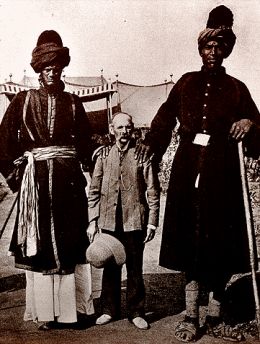
My grandfather was a very tall man (that's not him in the pic!) - they say he was around 6' 8". Whilst he grew vertically, I seem to have grown horizontally. Anyway, here's an article about giant people and their bones which have been found in the USA, Peru and Hawaii. Some great pics from National Geographic too.
So that set me Googling. Here's an incredible list of reported giant remains in the Ohio Valley, USA, from the mid 1800s.
Many years ago I found an intriguing old book in a now-long-gone dark musty (foosty) bookshop in Smithfield called The Giant Cities of Bashan and Syria's Holy Places by the Presbyterian minister Rev Josias Leslie Porter (1823 - 1889), published in 1863. Porter (whose address in the foreword is given as Brandon Towers, Belfast - just off Connsbrook Avenue in Sydenham) seems to have been an explorer / adventurer as well as a clergyman, as well the second President of Queen's University from 1879 until his death in 1889. He spent time in the Holy Land long before the turmoil and wars of the 20th century took hold; he spent 10 years as a missionary to Syria from 1849 - 1859.
The book is dedicated to the Right Honourable Lord Dufferin and Clandeboye, who himself was a renowned international diplomat and antiquarian, who has a large statue to his memory in the grounds of Belfast City Hall. His estate at Clandeboye even to this today contains a breathtaking collection of ancient artefacts that he accumulated during his time spent overseas.
The Holy Land was a largely deserted, abandoned place then, with its antiquities still standing, although by then many were in ruins. Strangely though, Bashan itself was very much intact. Porter wrote in the book that "...the cities built and occupied some forty centuries ago by these old giants exist even yet. I have traversed their streets; I have opened the doors of their houses; I have slept peacefully in their long-deserted halls..." A PDF version is available free on GoogleBooks.
He also wrote: "..."Moses makes special mention of the strong cities of Bashan, and speaks of their high walls and gates. He tells us, too, in the same connection, that Bashan was called the land of the giants (or Rephaim, Deut. iii. 13), leaving us to conclude that the cities were built by giants. Now the houses of Kerioth and other towns in Bashan appear to be just such dwellings as a race of giants would build. The walls, the roofs, but especially the ponderous gates, doors, and bars, are in every way characteristic of a period when architecture was in its infancy, when giants were masons, and when strength and security were the grand requisites. I measured a door in Kerioth: it was nine feet high, four and a half feet wide, and ten inches thick, - one solid slab of stone. I saw the folding gates of another town in the mountains still larger and heavier. Time produces little effect on such buildings as these. The heavy stone slabs of the roofs resting on the massive walls make the structure as firm as if built of solid masonry; and the black basalt used is almost as hard as iron. There can scarcely be a doubt, therefore, that these are the very cities erected and inhabited by the Rephaim, the aboriginal occupants of Bashan..."
So maybe the old Finn McCool / Giant's Causeway legends are right?!
Friday, September 26, 2008
Don't believe everything you read in the newspapers
I am told the News Letter are continuing their shabby campaign in today's paper by continuing to stoke up controversy around A Danner With Drennan. Sickening - particularly when they know the truth. I spoke to one of their journalists by phone last week, later emailed him and copied it to the Editor. But still the campaign continues. Newspaper sales must be down for them to resort to this...
Thursday, September 25, 2008
The power of music
A few weeks ago I spent an afternoon in Ballykeel with the local Presbyterian minister Martin McNeely and two men from the Kirk Session. To sit in a Starbucks coffee shop with three men I'd never met before on a drizzly Monday afternoon, talking about Robert Murray McCheyne (and other things too), was just great. I hope I was of some use to them.
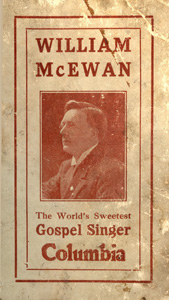
As we left, Martin loaned me two things: his copy of Memoir and Remains of R M McCheyne, and a CD entitled "Preachers and Congregations Volume 5: 1926 - 1931" (Document Records DOCD 5559). It took me a day or two to find a bit of clear time to sit down and listen to it, and it is superb. For me the standout track by far is "He's The One" (written by J B Mackay) sung by Rev H B Jackson and recorded in 1929. It's the best version of this hymn that I've ever heard, an old gem that we often listened to at home either on vinyl records or being sung by my mother. I've listened to it every day since, and have even played it to people who've called into the house. It has an almost William MacEwan vocal style, and just an old pump organ playing simple chords and melody. Hearing it is like time travel, to an era before electrified praise groups, when the old hymns of the faith were sung with pathos and sincerity. Here are the words:
Is there anyone can help us, one who understands our hearts,
When the thorns of life have pierced them till they bleed;
One who sympathizes with us, who in wondrous love imparts
Just the very very blessing that we need?
Refrain:
Yes, there's One, only One,
The blessed, blessed Jesus, He's the One!
When afflictions press the soul, When waves of trouble roll,
And you need a friend to help you, He's the One.
Is there anyone can help us, who can give the sinner peace,
When his heart is burdened down with pain and woe;
Who can speak the word of pardon that affords a sweet release,
And whose blood can wash and make us white as snow?
Is there anyone can help us, when the end is drawing near,
Who will go thro' death's dark waters by our side;
Who will light the way before us, and dispel all doubts and fears,
And will bear our spirits safely o'er the tide?
Great stuff! (PS it's 91 in Redemption Songs)
Wednesday, September 24, 2008
US Election again
I see that John McCain last night spoke of his Scots-irish roots, and has pledged to appoint a special envoy to Northern Ireland. Meanwhile over at The Independent, they see the Appalachian region as a place where Obama will struggle...
Monday, September 22, 2008
A Dairk July Mournin
(I'm not sure that I should be posting this at all.)
This is something of a sequel to A Bricht February Mournin, and is about my cousin Adrian. He was 2 years older than me and I grew up in his hand-me-downs. When we were wee his nickname was "Drain Drain". He died in July 2003 and I wrote this shortly after.
It's never been published, and has only been shared with a few people. Comparisons have been made with James Fenton's Minin Bab, but the similarity was unconscious on my part, and I would never claim to be anywhere near James' league.
I'm not going to say much about this, and given the circumstances it's better that way. Even though many of the references in this are too personal to be fully understood by people outside of our family, I'm sure you can work out what happened.
.........................
A cairryt
Her wae him. Doon tha brae
Past tha fiels whaur we kepped tha beese.
A cairryt
Him forbye. Alang tha shore
An pit him nearhaun her.
Tae leeve an dee
Siccan a road as thon
Must be dairk.
Whit for?
A'll niver fin oot
Yin big happy cratur... wae the worl' on his shouthers
Whit happent?
Hunners o tales noo.
Likely nane o them richt.
A wheen o nichts aforehaun
A taaked tae him for oors
Staunin an lauchin ootside - gettin caul.
13t o July. Black Day.
A pit my haun on his broo.
Caul. Nae lauchin.
A jist wush
A cud hae stapped him.
Listen't tae him.
A jist wush
He cud hae taaked tae yin o us
An no daen it ava
But we're aye that busy.
Nae time fer yin anither
Nae time.
Nae shoartbreid noo
Nae tay
Nae Drain Drain
Nae mair
A'll see him
Whaur he's wae her noo
Nae worl' on his shouthers ony mair
So there isnae
Sunday, September 21, 2008
The Scriptures in Scots
A few people have asked me recently about Scots language translations of the Bible. Here are my recommendations, with links to Abebooks where you should be able to buy a copy (if the sellers currently have any copies listed).
1. For a general overview of the various translations there have been:
• Graham Tulloch's A History of the Scots Bible (first edition 1989) - click here
2. For the most accessible and most appropriate for Ulster readers:
• William Wye Smith's New Testament in Braid Scots (1901) - click here
• William Wye Smith's Four Gospels in Braid Scots (1979 edition, extracted from the above New Testament) - click here
3. For the technically brilliant, but hard to read (in my own opinion)
• William L Lorimer's New Testament in Scots (first edition 1983) - click here
4. A more recent paraphrase (ie, not a verse-by-verse translation, but a blend of all four Gospels into one story)
• Jamie Stuart's A Scots Gospel (first edition 1985) - click here
5. An old classic:
• P Hateley Waddell's The Psalms in Scots (1987 reprint of 1871 first edition) - click here
6: Obscure but very good:
• Henry Scott Riddell's The Book of Psalms in Lowland Scotch (1857) - click here
There are many more (including a reprint of Murdoch Nisbet's translation which he may have worked on for a time in Ulster) but these are the most well known.
For first timers I'd advise getting Smith's Four Gospels in Braid Scots as a starter and then see how you get on from there.
Saturday, September 20, 2008
How do you get to Heaven?
Last week at bedtime, after we did what we call "nighttime prayers" with the boys, I asked Charlie "Now Charlie, how do you get to Heaven?". Expecting a simple, spot-on, theologically sound answer I nearly collapsed with both shock and laughter when he looked up at me and replied "You need a really big rocket with loads of petrol!". He then went on to explain that because Heaven is past space, that a normal rocket wouldn't be good enough. Thankfully, eventually, he got the answer right. Weans have a way with words.
Give Up Yer Aul Sins is a series of recordings from Dublin classrooms of the 1960s, of children re-telling Bible stories to their teacher. The audio has been set to new animations, and whilst the theology and cultural context leaves much to be desired (just one example from the voiceover "...when you want a miracle done you can ask the Blessed Lady, for she's His mother...", and the depiction of Christ is dreadful), otherwise the overall effect is lovely. Here's a YouTube clip on the life of Lazarus:
I notice from the endframes that these were funded by RTE and the Irish Film Board. What chance of getting BBC Northern Ireland and Northern Ireland Screen to fund and support sympathetic productions of the Protestant equivalent - stories of martyrs, missionaries and the Bible, with a rock-solid gospel message at their foundation? Parity of esteem? Not likely!
Scottish football
Rangers are playing Motherwell this weekend, in a game at Ibrox being marked by the fans as "Ulster Day" to commemorate the players from Ulster that have worn the famous blue shirt over the years. I am sure that sections of the Scottish media will go buck daft at the sight of the evil flag of Northern Ireland being flown at Ibrox by the thousand.
Anyway, in 1599, King James VI of Scotland wrote his Basilicon Doron, Book III. In it he warned his son to avoid "...all rough and violent exercises, as the football...". When he became King James I of England in 1603, he soon after commissioned his own translation of the Bible in order to replace the Geneva Bible.
I wonder what King James thought around 1620 when he found out that his old pal Hugh Montgomery had given personalised Geneva Bibles* to all of the churches he had built in his Co Down settlement estates, and installed a football pitch** in front of the "classics school" he had built in Newtownards? The school's first headmaster was John McClelland of Kirkcudbright. It was said of him that "...He was a most streight and zealous man; he knew not what it was to be afraid in the cause of God, and was early acquainted with God and his ways..."
Funny enough, an Ulsterman called John McClelland was Rangers captain during the early 80s. But I wonder how many of those Rangers fans will be reading from any version of the Bible tomorrow, whether the Geneva Bible, the King James Version or some other?
------------------------
* "...furnishing all those six houses of God (Newtownards, Comber, Greyabbey, Donaghadee, Kilmore & Portpatrick) with large Bibles, of the new translation, and printed Ao. 1603... which hath his Lordship's coat of arms, as Laird of Braidstane, stamped on the cover with leaf
gold..." from The Montgomery Manuscripts p 124/125
** "...built a great school at Newtown... allowing the scholars a green for recreation at golf, football, and archery..." from The Montgomery Manuscripts p 126
Tuesday, September 16, 2008
Torchlighters: John Bunyan and William Tyndale
When I went to Sunday School we got great stuff - I still have my illustrated Pilgrim's Progress, my Pictorial Old Testament (which is like a cartoon strip of the key events, book by book, from Genesis to Malachi). In my final year of Sunday School I asked for a copy of Hislop's "The Two Babylons" - not the typical read for a 13 year old! (I can hear the men in white coats coming for me now....)
For today's generation,Torchlighters is a series of children's animation DVDs about 'Heroes of the Faith". I bought two of them for our weans a few weeks ago, on the lives of William Tyndale and John Bunyan. Produced by the Christian History Institute in the USA, they are excellent and worth recommending as a Christmas gift for children in your family. They would also be good as an outreach tool for churches, perhaps run as a "Saturday morning cinema" in a church hall for kids to come along to.
I'm usually very dubious about this kind of thing, as they usually:
a) dilute the power of the original story to make them "relevant to today", which is usually coded language for "so as not to cause offence to anyone", and
b) the technical quality is usually poor, and a pale imitation of the standards of animation that children today are used to, and expect - thereby defeating the purpose of the whole thing.
The DVDs are available in the UK as a triple set (including Eric Liddell of "Chariots of Fire" fame) for £30 through Trinity Vision. Here are two preview clips from YouTube:
Our kids (10, 5 and 3) were enthralled. It's just a shame there are so few in the series - I can imagine a whole raft of these on Ulster-Scots-Gospel themes (the 1625 revival, the four ministers and Eagle Wing, The Covenants etc etc!). Maybe one day...
The Languages of Europe, 1951

The map above is a detail from a large wall chart map entitled The Languages of Europe that I found in Stacks Bookshop in Dundonald about 15 years ago. Dated 29 September 1951, it shows that the language of Ulster and lowland Scotland was/is Scots. The map was produced just after WWII following the Paris Peace Conference of 1946, by a Dr Aldo Dami of the University of Geneva. It was issued free with a publication called Map Review, edition 141.
Monday, September 15, 2008
A Bricht February Mournin
Philip and Maynard reminded me of this poem over recent weeks. I wrote it in 1995, following my grandmother's funeral - she died on 12th February, and I had to break the news to my father. He had turned 50 just 3 days before. The funeral "service" was held in her home, with friends and neighbours jammed into the wee room with the stove. We buried her at Ballyhalbert alongside her husband William, who'd died 48 years before.
The whole experience was deeply intense for me, I'd never experienced the death of a close family member before, and I'm not the type to go to every funeral in the locality. Maybe that's a generational thing - I know folk, like my da, who feels the need to be present at as many as possible, to show his respect and sympathy. I've not been at the funerals of a few elderly relatives over recent years, maybe that's bad.
My granny lived just over the fields from us, and was a big influence on me when I was growing up. Her husband, William Thompson, was the poet and he died in 1957, leaving her to rear five weans. The photo below is of her and me at the door of her wee house at Ballyfrench, around 1975, with her holding my brother Graeme.
The poem was written as a bit of catharsis, but to my surprise when I showed it to some other folk they liked it, and it was published in Ullans Nummer 7, 1999 and then in the 2003 book A Blad o Ulstèr-Scotch. For Maynard and Philip to be talking about it lately must mean it's had some kind of lasting impact on both of them, so here it is:
We cairryt her
Doon tha brae
By tha fiel whaur we kepp tha beess
Dizens o fowk ahin us forbye,
An tears wallin up in ma een.
Past tha enn o Skelly’s road
An by Sam Beggs’s loanen
Tha wun wus coul on Bellyfrench
Thon bricht February mournin
A wheen o fiels an a dizen o hens
She spent her days leukin efter
It gien her hauns somethin tae dae
Amang tha tears an tha lauchter
A hae mynn o tha day she wus bakin
Her shoartbreid wus burnt
A filled ma pokits
Wi black shoartbreid
Feart
Ma granny micht greet
We taen her tae Bellyhailbert
An laid her alangside her man
Whaur he wus waitin foarty-echt year
Leukin ower tha Sheugh tae Scotlann
A miss her
Whiles
A quair wee woman she wus
Bot A’ll see her yin day
An ma granda forbye
A’ll tell her o aa tha fuss
She gien us whun she left,
As intil tha grun she wus lowerin
An we happed her ower wi flooers an tears
Yin bricht February
Mournin.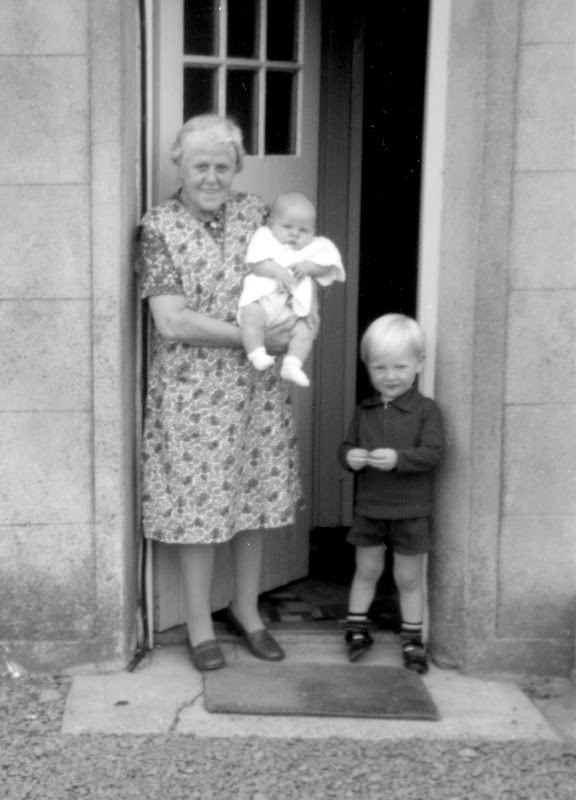
Saturday, September 13, 2008
Red Hand Rednecks™?
This is an interesting story from the BBC website on the McCain/Palin republican Presidential election candidates, who the author claims have : "...white Southern Scots-Irish values - redneck values..." He goes on to say "...The essentials of redneck culture were brought to America by what we call the Scots Irish, after first being shipped to the Ulster Plantation, where our, uh, remarkable cultural legacy can still be seen every 12 July in Ireland. Ultimately, the Scots Irish have had more of an effect on the American ethos than any other immigrant group..." And after all, McCain's election compaign has included the "No Surrender Tour", and he has an ancestor (Captain John Young from Armagh) who apparently fought with William of Orange at the Boyne. There's a recent thread on Slugger all about it (with all the usual tit-for-tat chitterin' reader postings too).
So as usual, everything that matters has an Ulster connection. To wrap up, here's another McCain who was in Ulster a few months ago, talking about his family heritage and politics.
...............
™ (I made that name up, so it's mine. The trademarked Ulster-Scots-American giftware range is currently in production)
Thursday, September 11, 2008
Address to a Nintendo DS
Here's another effort to inflict on you! A Nintendo DS is a wee hand-held computer game that has infested the younger generation, increasing the poverty of parents, and the disobedience and selective hearing of weans, the world over. This is about our Charlie (5 1/2) and his DS fixation:
Charlie an' thon oul' Nintendo
He near haes his ma roon the bend-o
Killin' things fae ooter space
Gubbin' them richt in the face
Ye cannae fin' him roon the place
He's awa' playin' thon oul Nintendo
Ye cannae get near the Nintendo
Charlie'll no gie ye a lend-o
Ye dinnae hae a chance ava
He's jumpin' left an richt an aa'
Spongebob Squarebreeks taks a fa'
Fae Charlie wi' thon oul Nintendo
Ye'd think it was glued tae his hands-o
Lego Star Wars an' then Super Mario
Cloddin' fireballs at fowk
Fechtin' Darth Vader's nae joke
His ma says he's goin' tae get choked -
If he disnae quat playin' Nintendo!
He cannae pit the thing doon-o
Even whun he's in the bathroom-o
He couped - it went fleein' across the room
It hut the toilet an' went doon
It gien a splash, an then it droon't
He kill't his beloved Nintendo
(but a wheen o' months later, efter weerin' doon his ma' an' da wi' gurnin' an' gan on, he got anither yin...)
When it's time tae go tae his bed-o
Charlie hides it richt unner his pillow
The blanket's pu'd up ower his heid
Ye cannae see him, jist his feet
Whit's that lit up alo the sheets?
It's Charlie wi' thon oul Nintendo
Nae doot Charlie's hooked on Nintendo
He's nae need tae even pretend-o!
Ye'd think he'd naethin else tae dae
But sit on his rear-enn an' play
"A'll redd ma room some ither day...
A'm on Level Five on Nintendo!"