Monday, June 08, 2020

The Scots language origins of Stable Hole, Portavogie


“Stable Hole” is an obscure, but sometimes very beautiful, wee cove at the north end of Portavogie, to which I regularly walk our dog or else land the kayak in. It's not named on modern maps, but so many Ulster-Scots placenames aren't; they are found in whatever local oral tradition remains.

Stable Hole is often soft and quicksandy – my uncle John has told me that when he was a boy it was sometimes ironically nicknamed “Purgatory” because if you went in you didn’t know if you could get out. (Theologically, the Presbyterian, Methodist and Brethren locals would have found that nickname ironic and amusing).

Well it turns out that the word “Stable” in the Dictionary of the Scots Language refers very specifically to “the part of a bog in which a foundered horse is trapped”. There is more depth to Scots words than lazy assumptions that they are nothing more than bad English. And the wee places have something to say.


Signs of the Times


Away back before Ulster-Scots became "officialised" under the terms of the Belfast Agreement in 1998, local community efforts were already working away to restore a sense of place.

This photo shows one of the "Fair Fa Ye" signs which greeted motorists arriving into the Ards Borough Council area, from memory these were installed around 1994-ish. It's a greeting used by William Starratt, James Orr and of course Robert Burns. Some of the Ards Peninsula villages also had brown signs installed to restore awareness of historic street names, alongside the blander names which had been introduced by policies in the 50s and 60s (see this previous post for Killyleagh examples). This restoration was all fairly positive and affirming stuff.

But, when Ards Borough Council merged with North Down Borough Council in May 2015, the "Fair Fa Ye" signs were all taken down. This was said at the time to be only a temporary thing due to forthcoming new council rebranding. Which was technically true, because new signs were indeed installed. But they are Ulster-Scots-free jaggy blue triangles which appear to be statements of corporate council power. The town and village arrival signs have little taglines about Rory McIlroy, the seaside, tasty spuds and suchlike. But the linguistic component is gone.

These (one might say 'sleekit') actions in 2015 reflect the same 'modernisation' policies of the 1950s and 1960s. The powers that be know better, and they literally have the 'power' to do what they want. There will of course have been a modicum of public consultation and a discussion at a Council meeting showing an exciting range of blue triangles that you can choose from. But once you enter the conversation about blue triangles, you have already conceded that blue triangles is what you're going to get. I know a few folk who exhausted themselves trying to fix it, to no avail.

Significant parts of Northern Ireland are run by a suburban-minded 'white collar supremacy' layer of policy makers.

Friday, June 05, 2020

Drawing upon 1798 - the Battle of Antrim, the Barn of Scullabogue, and the Bard of "Donegore Hill"


The anniversary month of June is upon us again, marking the Battle of Antrim (7 June), the Battle of Saintfield (9 June) and the Battle of Ballynahinch (12 June), as well as many local events and skirmishes around these dates. Two slightly different illustrations of the Battle of Antrim are below, by J.W. Carey, in one of which a flag bearing the word Liberty can be clearly seen. They're fairly romantic heroic artists impressions, from 1895.


• James Orr of Ballycarry
Also below is the Bard of Ballycarry James Orr's Old Testament reference-laden intro to his poem Donegore Hill about the events preceding the Battle of Antrim and the aftermath. Published in 1804, his account is far more realistic than the two visualisations by Carey. The rage in Orr's pen is evident. Why did so few "turn out"? Why does Orr rage at those who were "laith to lea the rigs"?


• Who Dares to Speak of Scullabogue?
Part of the answer might well be found two days earlier and 220 miles south in County Wexford at Scullabogue, on this day, 5 June, in 1798.

The illustration below is George Cruikshank's famous drawing of the burning of the barn at Scullabogue in Wexford, where the United Irishmen insurgents imprisoned almost 200 civilians, overwhelmingly Protestant, into a barn and set it on fire. It is as grisly as Carey's are heroic, with echoes of the engravings of Portadown bridge in 1641 and the barbaric images in early volumes about "The Killing Times" in 1600s Scotland. You can read more about Scullabogue on Wikipedia here.

It's widely accepted that news of the horrors of Scullabogue had a major effect on diminishing support for the Rebellion in Antrim and Down, although in Ireland: The Politics of Enmity (link here) Professor Paul Bew asserts that the reports hadn't come north before the Battle of Antrim - but that there was a further sectarian massacre on the bridge of Wexford just over a fortnight later on 20 June.


• Claims, allegations and invoking the memory
It was said that it was done in response to rumours that some of the United Irishmen who had been captured at New Ross were being executed. In later years, it was alleged that the barn atrocity at Scullabogue had in fact been carried out by agents of the Dublin establishment to purposely –

"palsy the efforts of the North at that more critical period of the people's cause ... that massacre was concocted in the Castle of Dublin ... the object was gained by this infernal scheme. The Northern Presbyterians, believing the story, gave up their arms ... national independence had been superseded and has merged into a religious warfare."
Yet in November 1869 in County Cavan, the Ribbonmen movement revelled in the power of the folk memory when they threatened local opponents with a proclamation they posted in public places around the county. It advocated the sectarian boycott of a miller named William Matchell of 'Killyconnell', and ended with "remember Scullabogue Barn and tremble".

The barn site was cleared in the 1990s; a memorial stone stands nearby today, with this message within the inscription –

The remorse of the United Irish at this outrage, a tragic departure
from their ideals, is shared by the people of Ireland.

This blog has more details. An ecumenical memorial service was held at St Mary's Church in Old Ross in 1998.

• The Two Henrys
Also, compare the memorialising of the two Henrys of Antrim and Down. Belfast Presbyterian United Irishman leader Henry Joy McCracken and his role the Battle of Antrim (as well as his public hanging but not beheading in Belfast) is a celebrated figure. Yet the Lisburn Church of Ireland United Irishman leader Henry Munro and his role at the Battle of Ballynahinch (as well as his public hanging and beheading in Lisburn) is nowhere near as well known. Maybe his Church of Ireland dimension just confuses the Presbyterian-heavy narratives which are so commonly told now. Or maybe Belfast sets the storytelling agenda.

• The Church of Ireland, the Presbyterian divisions, Inter-National and Ulster-Scots
1798 is very complex. There is much to learn from 1798, and how we remember matters. I think much of the remembering is well-intentioned but is not always well-informed. People are keen to find an era of heroic cross-community co-operation, a shining moment, and edited versions of 1798 provide that. Often the attraction is to what 1798 represents, rather than to what actually happened. Here are just a handful of examples –

• The Portaferry and Ballyhalbert Presbyterian minister William Steele-Dickson's account in his 1812 memoir Narrative shows that the Church of Ireland dimension was very significant - of the 20 leaders he listed by name and denomination, 4 were Catholic, 6 were Presbyterian and 10 were Church of Ireland (link here).

• The "Presbyterians = all of one mind" or "Presbyterians = good" or "Presbyterians = pro-Rebellion" simplifications that you come across today just aren't true. The Preface of Steele-Dickson's book shows that the Presbyterian Synod of Ulster had gone to war with him and had "laboriously struggled to prevail on Dr Dickson to degrade his character".

• There were atrocities in Ulster too carried out by United Irishmen. In a Scullabogue-like horror, a family called McKee were infamously besieged and burned to death in their farmstead home at Craigy near Saintfield - a family account of the event is online here. One of the wider family circle, Joseph McKee, went to Nashville and became a pioneer in educating African-American freed slaves (previous post here). The minister of St Mary's Comber, Rev Robert Mortimer, was shot dead in cold blood while travelling towards Saintfield and his body reportedly sent back home tied onto his horse.

• The connections with similar movements in Scotland and England are usually overlooked due to the limitations of concepts of nationality. The United movement was in a sense an 'inter-national' movement, with United Scotsmen and United Britons. Dickson made frequent visits to Scotland to develop those links and to propose a simultaneous rebellion there.

• That the language of the Antrim and Down rebellion was Ulster-Scots (weaver poets, WG Lyttle, Samuel Keightley, etc) doesn't sit comfortably with many.

• that so many of the thinkers and leaders were Freemasons hardly gets a mention these days, because it’s not socially or politically useful to do so. Yet culturally and historically that’s a pretty significant dimension

But complexity matters because convenient simplifications can be dangerous. The Presbyterian poet Francis Boyle lived in Granshaw, in the hinterland of Comber where so many United Irishmen were from and returned to. Published in 1811 his poem 'The Colonel's Retreat' ends with –

My friends, be admonished no more to rebel,
Its dreadful effects there's no Poet can tell,
It desolates countries, proves nations' o'erthrow,
Brings men to the scaffold like General Munro.

FURTHER READING –

• A History of the Rise, Progress and Suppression of the Rebellion in the County of Wexford (1829 edition) by George Taylor of Ballywalter in Wexford, is online here. Taylor had escaped from the massacre on the bridge of Wexford on 20 June 1798. It is a fascinating primary source and ends with his horrific personal testimony dated 18 July 1798. The illustration below is another by Cruikshank, a depiction of a murder taking place on the bridge.

• This review of Professor Tom Dunne's 2004 book Rebellions: Memoir, Memory and 1798 looks like a fascinating critique of the 'official' bicentenary commemorations in Wexford in 1998. Local councils in Northern Ireland were criticised in 1998 for not doing very much at all to mark the Antrim and Down events*, with some critics alleging that this was due to the mostly Unionist makeup of those Councils. Well it looks like the Wexford events can be viewed with an equivalent skepticism.

• Remembering 1798 by Professor Roy Foster is a strong read (link here).


* PS - I think there's a hint of conspiracy about this theory. In my experience, in general, local councillors have little influence over policy and sadly very few are passionate about local history anyway. But they are busy – they have day jobs, they are expected to be across multiple briefs, with various committees to attend in evenings and functions at weekends, and unlike the swarms of 9-5 public servants who are salaried to daily craft policies and yet more red tape, councillors just don't have comparable time to devote.

But the booklet that Ards Borough Council published in 1998 (previous post here) is an important one as it contains information not available elsewhere. The Mayor that year was George Ennis. He grew up in my area. I first met him around 1999 when he was trying to prevent bad planning policy wrecking Ballyhalbert, but he was a lone voice in that effort. I have always found him to be a quiet, straightforward and community-minded man with a genuine interest in local heritage. He didn't stay long in politics; I like bumping in to him when out and about and he always has a kind word to say about my own efforts. His preface to the booklet is below.


Wednesday, June 03, 2020

For good or ill, "what we plant now we will harvest later"...

... and no planting will mean no growth, and no harvest. The crops might fail but you still have to plant. Image below from New Garden Society design studio in Serbia, via Instagram here.


Wednesday, May 27, 2020

"The Psalms - Frae Hebrew Intil Scottis" by P Hately Waddell (1877) - review in the 'Belfast News-Letter', 10 May 1941

It took the Belfast News-Letter a total of 64 years to get round to reviewing it, but all the same their reaction was pretty positive. I wonder who 'Viator' was?


Saturday, May 23, 2020

The Hunt for Red O’Donnell


“Spanish Archaeologists have discovered human bones in their search for the remains of Red Hugh O’Donnell, one of the great tragic heroes of Irish history...” link here to this recent story in The Irish Times.

This will be a remarkable discovery of a key figure of late 1500s and early 1600s Ulster, around whom so many totemic stories revolve.

But compare the high level national excitement, south of the border, around this potential discovery with the fact that the burial places of James Hamilton (Bangor Abbey) and Hugh Montgomery (Newtownards Priory) have been known for nearly 400 years and neither of them even has a small memorial plaque. 

Friday, May 22, 2020

Consigned to history


History can be dull. It can be fascinating. But it is over. What happens today and tomorrow matters more. Because without those, all you have is a fossil, a museum, a nostalgia trip, a dead thing. What’s happening now? And why should anyone care?

Tuesday, May 19, 2020

James Kirkpatrick (1676–1743) on Liberty


"Civil Liberty has been always supported by invincible force of Argument; and, Civilized Nations have never reckoned it too dear a purchase, when they could gain and secure it at a vast expense of Blood and Treasure … and with a just Zeal for the Right: of Mankind never to be Sacrificed to Arbitrary Power in any Shape."

So wrote Scottish-born Belfast Non-Subscribing Presbyterian minister James Kirkpatrick (1676–1743). His essay A Defence of Christian Liberty was published in 1743, after he died, and is online here on Google Books. His An Historical Essay Upon the Loyalty of Presbyterians was published in 1713 (online here).

– biography is online here

Monday, May 18, 2020

Harry Dorrian (b. 1895) and the "Protestant Fenians of Greyabbey / The Green Lodge of Gray'ba""


During the current coronavirus period there have been many examples I've seen on social media of cross-community co-operation and good neighbourliness, folk I know personally being supportive of each other. One of them every week posts positively about all of the places of worship in the locality, and he posts four photos from the Greyabbey and Kircubbin area - of a Church of Ireland building, a Presbyterian building, a Non-Subscribing Presbyterian Building and the Catholic chapel -  as he puts it "we are all looking out for each other and thinking of each other". He's well-known and well-respected man of the older generation, has a small family business, and he's an Orangeman. He's a good neighbour to all, which is reflected in the comments that folk post.

He sent me the attached article a while ago, which I hope is legible here, from 1977. It's a biographical interview with Harry Dorrian who was then aged 82. He was raised in Greyabbey and had fond memories of his childhood in the village, and of what we today would call community relations. He's listed in the 1911 Census of Ireland as Henry Dorrian, aged 15, a 'shop boy'. Interestingly it reveals that his mother Mary Jane was from Scotland.

There has not only ever been conflict. Be suspicious of people who claim there has.
Cui bono? Those making those claims usually do.


Thursday, May 07, 2020

"Wha Saw The 42nd" – Robin Hall & Jimmie MacGregor


I love this hard-driving, banjo, mandolin and double bass version of "Wha Saw the 42nd?",  the story of the 42nd Royal Highland Regiment, also known as the Black Watch, leaving Glasgow for the front. There are many different versions of the lyrics.

Even though from Scotland the regiment recruited in Ulster in the late 1800s and early 1900s; its band played here, as the 1889 newspaper advert below shows. Also known as the "Gallant Forty Twa" they are referenced in the Ulster regimental song "The South Down Militia". The song is also the basis of our local Greyabbey version "Wha Saw the Greba Lasses?".

Wha saw the Forty-Second,
Wha saw them gang awa?
Wha saw the Forty-Second
Sailin doon the Broomlielaw?

Wha saw the Forty-Second,
Wha saw them gang awa?
Wha saw the Forty-Second
Sailin doon the Broomlielaw?

Some of them had tartan troosers,
Some of them had nane ava,
Some of them wore kiltie clothin,
Sailin’ doon the Broomie-Law.

Wha saw the Forty-Second,
Wha saw them gang awa?
Wha saw the Forty-Second
Sailin doon the Broomlielaw?

Some o’ them had jeelie pieces
Some were greetin’ for their ma
Some were singin ‘Auld Lang Syne’
Sailin doon the Broomlielaw

Wha saw the Forty-Second,
Wha saw them gang awa?
Wha saw the Forty-Second
Sailin doon the Broomlielaw?


This cutting below is of a man who lived at the "Pink Brae' outside Portavogie, who joined a Scottish regiment – Lance Corporal George Laidlaw of the Cameronian Highlanders whose postal address was given as Ballyeasborough, Kircubbin. There was still a family of "Ledlies" as it was pronounced still living at the Pinks when I was a boy in the 1970s & 1980s.

James Bruce - philanthropist who built Thompson House, Lisburn


The impressive building shown above was built by James Bruce (1835–1917), who was one of the directors of Royal Irish Distilleries / Dunville's. He traced his ancestry back to King Robert the Bruce of Scotland. Initally known as the Thompson Memorial Home for Incurables, Bruce built it in 1885 at a cost of £60,000 in memory of his father in law Dr William Thompson FRCSI. On its opening the Northern Whig said "rarely in Ulster has so large a sum been expended by any family on a purely philanthropic project". The architect was Godfrey William Ferguson. Today the building is known as Thompson House Hospital and it is said to have had a memorial to James Bruce inside it, which hopefully is still there.

The building looks very similar to James Bruce's country residence Benburb Manor, shown below, which was built just a few years later in 1888–90. It's a building I know well having completed an interpretative project there in summer 2017. Since 1949 it has been run by the Servite Order as Benburb Priory - it, and the setting of the Valley Park and River Blackwater, are definitely worth a visit when you are in the area.


Wednesday, May 06, 2020

The Ballad of William Bloat - by Raymond Calvert of Helen's Bay (1906-1959)


This famous and brutal old black comedy murder ballad is very well known, but its origin less so. It was written by Helen's Bay man Raymond Calvert, who lived at Banchory House and went to Bangor Grammar. He was a student at Queen's University where he was in the Dramatic Society.

In December 1926 they had just been to the Abbey Theatre in Dublin, where 20 year old Raymond recited it for the first time at an after-party. He went on to become a stockbroker as a director of Belfast firm Taylor, Calvert and Cox. His wife Irene became an independent MP. Irene later said that "it was conceived as a piece of fun with no political significance whatsoever ... the ballad has passed into the folk memory of Ulster people at home and abroad".

It is thought to have been first printed in the 1950 miscellany Brave Crack, An Anthology of Ulster Wit and Humour, (an interesting and cross-community collection from 30 writers including Marshall, Hayward and Bell) and is set on the 'Shankill Road' (the shocking and comedic cultural reference to 'solemnly cursed the Pope' just belongs in a mythical Shankill setting). The defective razor blade was 'German made' whilst the indestructible sheet was 'Irish linen'.

But when Raymond Calvert died, on 11 July 1959, the Belfast Telegraph reprinted the lyrics a few days later but they oddly say 'Newry Road' rather than 'Shankill Road'.

The 1982 Blackstaff Press edition shown here (illustrated by Hector McDonnell) has the more familiar 'Shankill Road' but this time the razor is more benignly 'foreign made' and again 'Irish linen'. I have, as you might imagine, heard the combination of 'Dublin made' and 'Belfast linen'. Wendy Dunbar won an Irish Book Design Award in 1983 for her work on the Blackstaff edition.

I've no idea who it was who first set it to the melody The Dawning of the Day but it fits perfectly –


Tommy Makem's recording here has the razor blade 'British made' but the rope 'Belfast linen'. The Phil Coulter recitation below has 'Free State Made' and 'Ulster Linen'. A Clancy Brothers version has 'English made' and 'Irish linen'. Just insert your own prejudice!

David Hammond referred to it in his 1978 Songs of Belfast. As an outstanding achievement it was also selected to appear in Kingsley Amis' New Oxford Book of Light Verse in 1979 due to a persistent campaign of persuasion by Gregg Coulson, a retired press officer with the Post Office in Northern Ireland. I wonder what its genteel readership made of it!

However... if I was a Shankill person I might not feel as relaxed about it. Yes it is humourous, but when a drama student from swanky Helen's Bay reinforces a whole panoply of stereotypes - social poverty, nagging wives, domestic violence, religious bigotry – it's worth pausing for thought.


In a mean abode on the Shankill Road

Lived a man named William Bloat;
He had a wife, the curse of his life,
Who continually got his goat.
So one day at dawn, with her nightdress on
He cut her bloody throat.

With a razor gash he settled her hash
Oh never was crime so quick

But the drip drip drip on the pillowslip
‘
Of her lifeblood made him sick.

And the pool of gore on the bedroom floor

Grew clotted and cold and thick.

And yet he was glad he had done what he had

When she lay there stiff and still

But a sudden awe of the angry law

Struck his heart with an icy chill.

So to finish the fun so well begun

He resolved himself to kill.

He took the sheet from the wife’s coul’ feet

And twisted it into a rope

And he hanged himself from the pantry shelf,

‘Twas an easy end, let’s hope.

In the face of death with his latest breath

He solemnly cursed the Pope.

But the strangest turn to the whole concern
Is only just beginning.

He went to Hell but his wife got well

And she’s still alive and sinning.

For the razor blade was German made

But the sheet was Belfast linen.


Tuesday, May 05, 2020

Andrew A. Watt & Co. Ltd. Whisk(e)y Distillers - Londonderry and Glasgow

As 16th May is World Whisky Day I thought I should post something relevant. Andrew A. Watt & Co. Ltd. of Londonderry and Glasgow claimed an origin year of 1762. The mirror above was recommended to me by Abby Wise who had frequently seen it when visiting the George IV Bar on the George IV Bridge in Edinburgh. I now badly want one of them!

The Watt family had moved into the city from Ramelton in Donegal in 1762. They had two firms – Andrew A Watt & Co., and David Watt & Co., at Abbey Street and the Waterside.

Andrew Alexander Watt (Wikipedia here) was also a director of The Distillers' Company Ltd (Edinburgh), which had been founded in 1877 and owned a number of Scottish distilleries, as well as Chairman of United Distillers Ltd (Belfast) which included the Avoneil and Connswater distilleries. He closed the family business down in 1921 following a dispute with employees. He died at Easton Hall, Grantham, England on 11 October 1928, leaving £904,614 in his will.

Distillery Brae on the Waterside is one of the few remaining memories of this once mighty brand. It was famous for its Tyrconnell Irish Whisky (a brand which still exists today, but owned by a different distillery) and also its Craigdhu Old Highland Scotch Whisky. The firm had an agent in Glasgow based at 20 Union Street.

The company was succeeded by a new firm inventively called Iriscot Limited, seemingly around 1937, with Geoffrey Watt as one of its directors. Iriscot continued to make Craigdhu and other products up until 1972 when their bonded warehouse building, at the junction of Bond's Hill and Simpson's Brae, burned down.

• Further information is on this website.


Saturday, May 02, 2020

"Independent mind" - Thomas Wallace Russell (1841-1920) - Part Two


Intro: 100 years ago tomorrow, on 2 May 1920, Thomas Wallace Russell died at his final residence of Olney, Terenure, in south Dublin, at the age of 79. He was buried in Mount Jerome Cemetery in Dublin. His obituaries portray him as having been a complex, contradictory and conflicted man. But maybe that's what life does to us all...

• Early 1895
The death of his wife Harriet had certainly caused Russell to reflect on his life, but it didn't knock him off course. His prolific writing resumed, sharp attacks in the press continued, and by summer he was back in campaigning mode. He delivered a lecture in Fintona Presbyterian Church at the end of March, mainly recounting some of his experiences touring Canada and the USA. At Fintona he of course majored on Land Reform, reminding his audience that he was "standing between the extreme Land Leaguer and the extreme landlord".

He had been to Canada in 1892 and 1893, speaking to large crowds of Ulster expatriate audiences about Home Rule, and specifically opposing the pro-Home Rule stance of Edward Blake, the second Premier of Ontario. Russell had packed Montreal Opera House in January 1893. During the trip he studied the Canadian system of government, perhaps to see if any of that could apply to Ireland, but feared that Ireland might become as theocratic as Quebec.

• 1895 General Election victory

Standing once again in South Tyrone, Russell was opposed by the Methodist pro-Home Rule Thomas Shillington of Portadown, and won by 3239 votes to 3046. When the result was declared, three bands accompanied Russell and his campaign team into Dungannon – the Moygashel Flute Band, Dungannon Conservative Flute Band and the No Surrender band – where thousands of people had gathered to welcome him to the same Market Square where he had addressed large crowds before –

"although it rained during the whole evening it did not mar or prevent the loyal men of South Tyrone of celebrating and rejoicing over the grand victory they had obtained by sending the loyal, Unionist and farmer's friend Mr T.W. Russell, to represent them in Parliament. Bonfires and torchlights were kept up to a late hour. All passed off peaceably". – Belfast News Letter 27 July 1895

"South Tyrone has once more proved its loyalty to the Constitution, and shown that it cannot be bought by wither Irish Nationalists or English Separatists" – Tyrone Constitution, 2 August 1895.

One of the career outcomes for Russell was that in July 1895 the new Conservative government, led by Prime Minister Lord Salisbury appointed him to the role of Parliamentary Secretary of the Local Government Board.


• 1896: Remarriage, to Martha Catherine Keown
In October 1895 Russell announced his intention to marry again. Martha Keown was related to the late William Keown MP of Ballydugan near Downpatrick; she was the daughter of the late Lieutenant Colonel Keown of the 15th Hussars. She was also a niece of the Archbishop of Armagh, William Alexander, who conducted the ceremony at St Andrew's Church (shown here), Ashley Place, London on 25 May 1896. It was a quiet service with few guests, after which the couple honeymooned in Scotland. The church is gone now, demolished in 1953. The HQ building of John Lewis stands there today.

From the British Newspaper Archive, Russell's life for the next few years is the usual fare - public constituency meetings in towns like Aughnacloy, Clogher and (the) Moy, Parliamentary business, spats with opponents.

• 1899: Cracks appearing - 'black sheep in the fold'
In 1899 tremors were being felt in South Tyrone and he felt obliged to write to the press to request a special meeting in the constituency "to give me an opportunity of explaining my position and defending myself from attacks made in my absence". Rev Thomas Adderley from Ballygawley wrote an open letter to Russell which was published in the Freeman's Journal of 14 June 1899 which said "there are black sheep in every fold even as we believe you are one yourself".

Among other things, Russell vocally supported the establishing of a Catholic university in Ireland; the News Letter opposed him, the Northern Whig supported him and alleged there was a clique trying to oust him. It looks like Russell was on a collision course, caught between the two positions of what we call the 'constitutional question', and hoping that a completion of full Land Reform in Ireland might somehow satisfy both sides and preserve the United Kingdom of Great Britain and Ireland.

• December 1899: Back to Scotland
There were rumours that Russell was going back to Scotland at the next election, to run in Glasgow.

In December Russell was back home in Cupar in Fife, where he addressed an audience on the subjects of the Boer War, the United Kingdom, and temperance reform, in which he said "in the main, the drink power was on the Unionist side, while temperance was with the Liberals". Certainly when you look at the background and politics of the Belfast distillers of that era Russell was correct. He went on to celebrate that he had helped "defeat and destroy two Home Rule Bills", and detailed all of the ills with which Ireland had been troubled during the past 100 years, which had resulted in "hatred of England".

• 1900 Russell's "extraordinary volte face"
Eventually, Russell would need to choose a side, and it seems that he decided to make overtures towards the Nationalist audience.  The Derry Journal ran an article entitled 'Mr T W Russell Adjusts His Muzzle'. Regardless of 1899 public disagreement with Rev Adderley, in July 1900 Adderley was one of those who once again selected Russell to run in the General Election to be returned as MP for South Tyrone.

• The Clogher Speech
On 20 September 1900, to launch his election campaign to an public audience of mainly Unionist voters, Russell delivered a single-issue speech on his proposals for 'compulsory land purchase'. He was received with loud applause, and aimed his verbal firepower at landlords, land agents, administrators and lawyers, as well as Unionist grandee Colonel Saunderson. Russell said the scheme 'would light a fire throughout Ulster which would not easily be put out' and that 'in the new Parliament there would be a real united Ireland on this question'.  Within days the speech was bring reprinted in pamphlet form on public sale.

Within days, Dromore born farmer's son William Gibson, (who was by then the founder of the Goldsmiths and Silversmiths Company Ltd in London and an occasional patron of arts and literature) wrote an open letter to Russell, via William Richey of the Clogher Poor-law Board, commending his 'magnificent scheme ... this is the one thing required to make Ireland prosperous ... it is now in the hands of the farmers and traders of Ireland to remove the sole cause of all the trouble of the past', and offered to host four Co Down farmers to stay in London at Gibson's expense to lobby Parliament for up to two years, with the aim of gaining Parliament's approval for Russell's scheme. The Gibson Trust still exists today.

A week later the Irish Landlords Convention were going berserk, saying "we desire to protest in the strongest manner against the scheme of spoilation and confiscation just propounded by a member of the Government, Mr. T. W. Russell, under the name of compulsory purchase, and also against his numerous misstatements and inaccuracies respecting Irish landowners."

• The 1900 South Tyrone victory
He ran again as a Liberal Unionist, against Independent Nationalist candidate Edward Charles Thompson; the two men were personal friends, and mutually recognised each other as 'honourable opponents'. On Friday 12 October, in his victory speech at the successful count at Clogher courthouse, Russell showed his hand in what was reported as a 'Remarkable Speech by Mr Russell'. He said that

"... the landlords and their followers had turned against him, and had done their best to oust him from the position which he had filled for fifteen years ... a number of sensible Nationalist farmers had noticed the landlords' trick and had helped to return him as their candidate ... he had endeavoured to act fairly to all parties in this country ... he hoped that Roman Catholics and Protestants, Unionists and Nationalists alike, would be benefitted, if he were spared, by his labours ..."


• A ‘vicious, little, teetotal, radical Scotchman’
Writing to the Marquess of Salisbury in 1900, the Duke of Abercorn described Russell as a ‘vicious, little, teetotal, radical Scotchman’. Salisbury in reply wrote, ‘I think he would keep his head better if he returned to alcohol.’ (NB – I must express my thanks to the friend who emailed that gem of a quote to me!)

December saw a public fallout between Russell and Sir William Moore, MP for North Antrim, and public talks being given by Russell at Fisherwick Place Presbyterian Church in Belfast as well as back in Clogher.

• December 1901: Ireland and the Empire, A Review 1800–1900
Russell expanded his thinking even further in book form, just before Christmas 1901 when he published Ireland and the Empire, A Review 1800–1900, which is on Archive.org here. The chapter entitled 'The Two Irelands – The Ulster Problem' from page 258 onwards is particularly interesting.

A row about it ensued in the pages of the Northern Whig, it was praised in the Irish News by William Redmond. The London Evening Standard was unimpressed, saying that 'Mr Russell is the hero of his story ... no-one can say positively whether Mr Russell is still a Unionist'. The Dundee Evening Telegraph review said "the book is written with the directness which one is accustomed to have from the writer when he is on the platform... Mr Russell still claims to be a Unionist, but the whole plea of his writing is for a very decided form of Home Rule ...".

But maybe binary politics could never be an arena that Russell's ideas would succeed in.

• 1902 East Down election
Amidst the furore surrounding the content of the book, the next target for Russell was the by election in East Down. Campaigning began in mid January 1902, and his man of the moment was Monaghan-born James Wood, with their messaging focussed on Russell's high-profile land reform proposals. And the small tenant farmers of East Down were on board.

Part Three to follow...


Wednesday, April 29, 2020

Another "man o' independent mind" - Thomas Wallace Russell (1841-1920) - Part One


Background and Intro
We should have been in Fife, one of my favourite parts of Scotland, for a week over Easter but the current coronavirus 'lockdown' ended that. I've been visiting Fife off and on since 1991 when I was 19 and had completed my Foundation Year at the University of Ulster's Art College in Belfast and had interviews lined up to do a three year design degree at various art colleges including at Glasgow, Edinburgh and Dundee. So I travelled around Scotland by bus and train for about a week in April '91 and crashed on spare beds and sofas of various friends' student accommodation in Glasgow, St Andrews and Dundee. Below is a photo of one my mouldy bus tickets from my scrapbook of the trip.


Fife is superb grain growing country, as demonstrated in the small village name Kingsbarns and the distillery there – when I visited it last year a staff member I dealt with had family in Bangor. Fife's 'East Neuk' is a necklace of beautiful wee fishing villages, much prettier and better conserved than those of my own Ards Peninsula.

Fife has a strong sense of its own identity, with the Firth of Tay to the north and the Firth of Forth to the south, with road and rail bridges across both. It proudly calls itself 'the Kingdom of Fife', thanks to a Pictish kingdom of the 6th century.  King Robert the Bruce is of course buried, sans heart but with bronze-cast skull, in Dunfermline Abbey. The Scottish Reformation first took off in 1520s St Andrews and then Dundee. 100 years after that the Covenanters were strong in the area – Richard Cameron was born in Falkland around 1647-8 where a plaque marks his home. Renowned Ulster Presbyterian minister of Bangor, Robert Blair, completed his career at Aberdour where a large memorial plaque on the exterior of his last church commemorates him. Robert Echlin, the episcopal Bishop and fervent opponent of Blair and all of those first Ulster-Scots Presbyterians (who, on his death bed, famously said he was dying of a 'guilty conscience') was from Fife before he relocated to Ardquin near Portaferry. Fife also has a rich Scots language tradition, as Mary Murray's famous 1982 In My Ain Words book shows. The song my mother taught me called Some Say the Divil's Deid (and buried in Killarney) has a Fife version Some Say the Deil's Deid (and buried in Kirkcaldy). Even Johnny Cash's ancestry has been traced back to the village of Easter Cash in Fife.

As this previous post shows, on a July 2008 visit to Fife I got up very early to go to the town of Cupar, just to take a photograph with the sun at the right angle of the gravestone of the Covenanter David Hackston (Wikipedia entry here) at Cupar Parish Kirk, who had been executed in Edinburgh on 30 July 1680. The previous year of 1679 had seen major state repression of the Covenanters and the consequent battles at Drumclog and Bothwell Brig where Hackston had been in a command role. He was one of a group who had planned to ambush the Sheriff of Cupar, but they ended up killing the Archbishop of St Andrews, James Sharp, instead. We were back in Fife again last February and I stopped off at Cupar to see Hackston's gravestone again. The only part of his quartered, dismembered, body that was buried there was his hand, which is why it is the central carving on the ornate stone, with a memorial poem on the reverse side.

..............................................................................................................

Ulster's connections with Scotland are usually assumed as being with the west coast, but in fact they reach into almost all parts of the country. The story below is just one of the many east coast links –

• of a driven working class Scot who moved to Ulster
• became a champion for temperance and land reform
• devoted much of his life to the right of tenant farmers to buy their parcels of land from the landlords
• became the MP for South Tyrone
• had a group of like-minds who became known as 'Russellites'
• for nearly 20 years was utterly committed to maintaining the United Kingdom and travelled its length and breadth to campaign for it
• but after all that, around 1900, changed his mind in what was later called 'an extraordinary volte face'

NB: I'm not into political history much, which I find is an area of either great expertise, or supreme geekery! It's the cultural and integrated Scottish/Ulster/Ireland/UK dimension of this man's life that interests me. And it's very easy to get lost in the weeds of the complexity of the 60+ years that land reform took, so this is just a simple attempt to assemble a story.

Photo above of Cupar from this conservation area document.
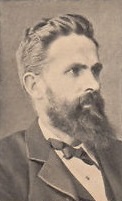

Sir Thomas Russell, 1st Baronet - Wikiwand• Thomas Wallace Russell – birth and early life
The part of Cupar in Fife known as the West Port was the birthplace on 28 February 1841 of Thomas Wallace Russell. He was the son of David Russell, a stonemason originally from nearby Kingskettle, and Isabella Wallace. David Russell had been a colleague of Hugh Miller, the stonemason's apprentice who became a famous geologist.

Thomas's grandfather had been evicted from his tenant farmstead and this burning family memory was Thomas's fuel throughout his life. The tenant right newspaper the Ballymoney Free Press of 13 March 1902 quoted him as saying –

"... I am the grandson of an evicted tenant – a man who left his all upon a Scotch farm and went out upon the world penniless and ruined. My father was silent. The grandson has broken out ..."

The family were Free Church of Scotland people; Thomas was educated at the Madras Academy in the town, after which he worked for a time in a grocer's shop.

• From Fife to Dungannon
Russell moved to Ulster in 1859 aged 18 and settled near Dungannon, possibly at Donaghmore. He always used his full name, or else T.W. Russell, perhaps to distinguish himself from his famous Ulster namesake and predecessor. He became secretary of the town's branch of the YMCA which was set up in September 1861 with Major Stuart Knox MP as its President and a young Thomas A. Dickson as its treasurer. It appears that, far from the corny Village People cliché of our era, the YMCA was a very well-connected organisation with the kind of networking opportunity that its ambitious members could make use of. The newspapers of the time have lengthy articles reporting on the activities and meetings of the Dungannon branch, many of which are authored by Russell.

In September 1863 Russell represented the Dungannon branch at the YMCA 'Universal Conference of Delegates' for one week in London. However, the co-operation between secretary Russell and treasurer Dickson would, 30+ years later, be turned to rivalry and rancour.

Russell became a paid representative for the Irish Temperance League and was highly active as a speaker on social reform all over Ireland, even lecturing in Scotland in the Union Street Hall in Cupar on his visits home. Russell honed his oratorical and writing skills quickly.

• Marriage and the move to Dublin
On 29 September 1865 aged 24 the Presbyterian Russell married Harriet Wentworth Agnew, the daughter of Methodist merchant Thomas Agnew of Dungannon, at St Anne's Church of Ireland in the town, with the service conducted by Rev William Quinn of Drumglass and Rev J B Kane of Annaghmore. Thomas and Harriet eventually settled in Dublin where around 1870 Thomas became an insurance agent, secretary of the Dublin Total Abstinence Association, and opened "The Russell Temperance Hotel" at 102 Stephen's Green South. He travelled all over Ireland championing the cause of temperance, and was a frequent lobbyist at the House of Commons where he became a familiar face.

• Land Reform
Ordinary people did not own land. In 1870, 97% of farmers – of all religious backgrounds in every county in Ireland – were tenants of landlords. A new law called the Landlord and Tenant Act was passed that year, By 1881 the Land Law Act was passed. Change was coming and land ownership was a massive political issue.

• Entry to Politics - Dublin and Preston
Aged 43, Russell stood for election in Dublin's Royal Municipal ward in 1884 as a pro-Sunday closing of public houses candidate, and one of his nominees was the Quaker tea and coffee entrepreneur Samuel Bewley Jr, a brand name still very famous in Dublin and Ireland today.

In 1885 Russell unsuccessfully stood as a Liberal Party candidate at Preston in the north west of England. It looked like he might win, but the vote was swung by a last-minute intervention from 'Parnellites' in Ireland to mobilise the Irish and Catholic population of Preston to vote Conservative to oppose Russell (source Fife Herald 23.11.1889).

Soon after, the leader of the Liberal Party, William Gladstone, introduced the First Home Rule Bill. So Russell left the party due to his Unionist convictions, but Land Reform was his real passion, and local campaigns to overturn landlord domination and allow tenants to buy the land were growing. But Gladstone's endorsement of 'Home Rule' brought a new, complicating, political context.

As ever, this caused polarisation in Ulster and Ireland with the all too familiar outcome. The fallout included the formation of both the Irish Protestant Home Rule Association and the Ulster Liberal Unionist Association.

• 1886: MP for South Tyrone
Back north to the Dungannon area and in 1886 Russell was selected as Liberal Unionist candidate for South Tyrone - an election he won, with a majority of just 99 votes, ahead of William O'Brien, who among many things was the editor of United Ireland (Wikipedia here) and the author of the "No Rent Manifesto" during a period of imprisonment in 1882.

That same year Russell delivered this searing address in Grangemouth, using a Biblical turn of phrase which I remember Alex Salmond also using some years ago –

"... What, I ask, have they (the Ulster Unionists) done that they are to be deprived of their Imperial inheritance, that in the words of the Apostle they are to be made ‘bastards and not sons’. Three hundred years ago Ulster was peopled by Scotch settlers … The men there are bone of your bone, flesh of your flesh … they read the same Bible, they sing the same psalms, they have the same church polity. Nor have they proved altogether unworthy of their ancestry…The descendants of these men have made Ulster what it is ..."
– quoted in Intimate Strangers: Political and Cultural interaction between Scotland and Ulster in Modern Times by Graham Walker (1995), p. 31. 


However even in victory Russell divided local opinion - the Tyrone Constitution of August 1887 shows that a Church of Ireland rector called Rev Thomas Ellis, and a small but influential section of local Orangemen, were opposed to Russell's stance on land reform for tenants. Those who were supportive of Russell were quick to write letters of support to the paper, and so in September Russell organised a large public meeting of over 1000 people in Dungannon Market Square to state his case openly once again. Russell was never an Orangeman himself, but that particular meeting was chaired by Captain William Brown, the District Master of Castlecaulfield.

In 1889 when Russell was back in Cupar, he addressed the East of Fife Unionist Association in the fishing village of Anstruther (pronounced 'Ainster'), with the Fife News saying that "the visit will not fail to be the political event of the year on the coast". He also spoke in the Town Hall of Leven, a town said to be "the most impregnable fortress of Gladstonism". The land issue remained his overarching passion. Russell proclaimed –

"... the toiling artisans of Belfast and for the farmers and labourers of Ulster, who absolutely refused to take in exchange for the Imperial Parliament of Great Britain and Ireland a vestry on College Green filled by men who signed the 'No Rent Manifesto' ... a picture of Ireland that was repeatedly presented just now to the British elector showed that island as a bleeding country, crushed by unjust laws and coercion and trampled upon by a tyrannical and despotic Ministry. 
But he spoke of a better island than that ... for Ireland the question of land was the supreme question...  with an earnest appeal to Scotsmen not to cast their kinsmen of Ulster adrift ..." (source Fife Herald 23.11.1889)

He was on such a high after the meeting that he declared his intention to return to Scotland in order to stand in East Fife in the 1892 General Election, against the future Prime Minister, Herbert Henry Asquith. In 1889 the Sheffield Daily Telegraph said that –

"One of the most hated Unionist MPs is Mr Thomas Wallace Russell MP. He has earned the hatred of the Parnellites, both Irish and British, by the fearlessness with which he has upheld the cause of the Union; the unerring accuracy of his statements; and the unflagging diligence which which he has employed himself in personally acquiring information on the Irish land question".

The Dundee Advertiser of 3 February 1890 said that:

"Mr Russell is not an Irishman, nor an Ulster Scot, having first seen the light in Cupar Fife, but he is an Ulster member. He had the honour of defeating Mr W. O'Brien in one of the divisions of Tyrone ... he believes all he says and does not speak for mere effect ... although he has spoken the same speech scores of times, it is always like a hot lava stream. With the exception of Colonel Saunderson, Mr Russell is the only Ulster Unionist the constituencies on this side of the water are familiar with ... Mr Russell is not an Ulsterman at all and he is getting tired of going about alone telling Scotch and English audiences that the Ulster people are honest, industrious and prosperous. What is Ulster doing? How many of her members go out to meet the avalanche of lies with which Great Britain is deluged?".

• 1892: Russell v Dickson
In a year now best-known for the Ulster Unionist Convention in Botanic Gardens of 17th June, at which Russell was present (and was first to endorse a motion from the Lord Mayor of Belfast), he was reported as saying

"... the men of Ulster that day were, indeed, making history. They had no quarrel with their fellow countrymen, but they objected to the system of domination which their fellow countrymen would put them under ..."

The contemporary illustration below shows Russell fourth, in between Rev Dr Richard Rutledge Kane and Thomas Sinclair.


Russell remained focussed upon South Tyrone and stood again as a pro-Union and Presbyterian candidate there in the July 1892 election. The twist in the story is that his opponent this time was his former YMCA pal Thomas A. Dickson, who was now a pro-Home Rule Presbyterian, and had previously been an MP for Dungannon from 1874-80, MP for Tyrone from 1881-85, and had also been MP for Dublin St Stephen's Green - where Russell's own Temperance Hotel was - from 1888-92 (Wikipedia here).

Russell won by 372 votes. The Freeman's Journal of 15 July 1892 detailed the rancour after the count, alleging Russell had 400 bogus votes. Dickson said he –

"... was defeated by the Presbyterian and Protestant farmers to whom he had devoted 18 years of his life... their eyes would be opened as to where their true interests lie ... he would never forget the support he had received from the Church of Ireland, from his own Presbyterian co-religionists he received nothing but the most unscrupulous opposition ... Presbyterian ministers standing beside ballot boxes and intimidating men who had voluntarily offered to vote for him..."

A momentum was now gathering around Russell as a figurehead within the broadly Unionist and Presbyterian rural community. At a meeting in Ballymoney Town Hall, organised by the renowned Rev J B Armour and at which Russell's old friend and recent adversary Dickson was due to speak, another speaker alleged that the Conservative party was being "led round on a chain like a performing bear ... dancing to the tune of Mr T.W. Russell" (Northern Whig 7 Sept 1894).

• Celebrity beckons
It is often unkindly said that politics is showbusiness for ugly people. Even though something of a lone figure, Russell was box office. A search for 'T.W. Russell' on the British Newspaper Archive for 1890–99 gives over 25,000 returns.  He spoke at events the length and breadth of Great Britain and Ireland to large audiences. In June 1893 the periodical World ran a lengthy 'puff piece' entitled 'Mr T.W. Russell, M.P., Celebrity At Home' which reads like a lifestyle article in the Tatler or a segment from MTV Cribs, from his London townhouse home at Ashley Gardens, Westminster. It was widely reprinted in local weeklies like the Sheffield Evening Telegraph.

"... the decorations, the hangings, the furniture, and every aspect of the rooms bespeak what the argot of the day calls 'modernity' ... everything is as bright and cheerful and home-like as the loving labour of two charming women can make it. During the last season or two Mrs and Miss Russell have become known in London society... 
during the past six or seven years few personalities have become better known to the public than Thomas Wallace Russell for he has traversed the entire kingdom and addressed over 800 public meetings in defence of the great cause to which he has devoted his life ..."

• 1894: Death of Harriet Russell
Suddenly, at what was then the high point of her husband's career, Harriet Russell died of pneumonia on 31 December 1894, at their home at 103 Stephen's Green, Dublin, aged 53. This followed 'a chill' she experienced on Christmas morning at a church service in a Methodist chapel close to where they lived. The funeral cortege left the house at 9.30am on 5 January bound for Amiens Street train terminus (now Connolly Station), to take her body back north to be buried in the Agnew family plot in Dungannon. The Dublin Daily Express of 1 January 1895 warmly remembered her charitable and temperance work, and reported that

"... his friends all over the United Kingdom will learn with deep sorrow of the affliction which has fallen upon him ..."

On 15 January the Northern Whig published the funeral tribute which had been given by Rev Dr M'Cheyne Edgar of Adelaide Road Presbyterian Church in Dublin, saying she had been Thomas's –

"... chief support, his best advisor, his most reliable co-worker ... a mind and will reinforced and strengthened by Christian principle ..."

The united choirs of the Presbyterian and Church of Ireland churches in Dungannon sang "For ever with the Lord, amen so let it be" just before her interment - a combination which says much about the Russells. Their daughter Edith was their only surviving child, an elder child having died in 1874.

Who knows what effect such a bereavement had on 53 year old Thomas Wallace Russell. But there are signs that his mind was starting to change.

• 1895: A Change is Gonna Come
The letters pages of the newspapers for January show that Russell was as active as ever, but the Northern Whig on 17 January quoted him saying, regarding the loss of his wife "... my first impulse would be to give up everything and retire absolutely from public affairs ... when the shadow passes a little I hope again to face those duties...".

Yet his more hardline Unionist opponents still harangued him in the press, often due to his frequent alignment with John Morley who had been Chief Secretary for Ireland. In February Russell penned this letter to Fortnightly Review, which was widely reprinted elsewhere –

"... I am a convinced Unionist. I have told the Ulster farmers that I am a Unionist first and a land reformer after that. But why am I devoted to the Union? It is because I believe that the Imperial Parliament is alike able and willing to do everything for Ireland better than an Irish Parliament can possibly do it. 
Take this belief away, convince me that on this vital issue the Imperial Parliament, as such, is unable or unwilling to do justice – I say that, if I am brought face to face with such a situation, the platform on which I have firmly stood crumbles away... 
... my conduct has brought me into collision with political friends. It has, to a certain extent, divided the Unionist party in Ulster. It has made my own battle in South Tyrone harder perhaps than it need otherwise have been.
For the country, for the Union, for the people, there is no safety but in an honest effort to do justly between the two contending parties on this, the great Irish question..."

(Part Two to follow...)
Monday, April 27, 2020

BBC Scotland 'Rebel Tongue' with Alistair Heather - on tomorrow night


This brand new programme, about the Scots language, presented by Alistair Heather will be excellent. A pre-broadcast review is online here. On BBC Scotland tomorrow night and on iPlayer for 30 days afterwards here. I've met Alistair twice, and we have high hopes of working together on a wheen o things later this year, aa bein weel.