Elsewhere on this blog, many years ago, I posted a few things about Murdoch Nisbet the Bible translator from Loudoun near Newmilns in Ayrshire, who translated John Wycliffe's 14th century English translation text into Scots. He worked in an underground basement he had dug for himself to escape the suspicions of the authorities – "... digged and built a vault in the bottom of his own house, to which he retired himself ...". This vault was said to be on the site of the later Loudoun Manse* or some have said Hardhill Farm. Nisbet fled Scotland for a while. But not only did Nisbet translate the Scripture - he started his work by translating Martin Luther's 1522 Preface to the New Testament.
Why is this important? Well, it means that - literally hot off the (German) presses - Luther was making an immediate impact upon Scotland, and western Scotland at that, not just the eastern coast's North Sea ports which German ships were trading into. There is more to unravel about this in future blog posts. Chapter 12 of the recent book Literature and the Scottish Reformation has some solid research on Nisbet (see here on GoogleBooks).
Below are some digital pics of my 1903 Scottish Text Society three volume printed edition of Nisbet. The original manuscripts exist somewhere in the British Museum. It is a shame that it is out of print, with the 500th anniversary of Luther's 1517 Reformation happening next year.
* Loudoun Manse was where a Rev George Laurie would live in the 1760s, who was a great patron of Robert Burns. Laurie's grandfather had been minister at Macosquin near Coleraine in the 1600s.
Thursday, March 10, 2016
Martin Luther in Scots, 1520-something?
Wednesday, March 09, 2016
"Scotch-Irish faces that were not given to smiling threw off their masks with reckless abandon"
So reads one review of Jean MacDonald, a Canada-born entertainer of Scotch-Irish ancestry on this 1926 publicity leaflet. Interestingly her management agent was Redpath Vawter of Cedar Rapids, Iowa, a town with long connections to Ulster through the Sinclair family's global business empire which had begun in Belfast in the 1800s.
Tuesday, February 16, 2016
A new first minister?
We have a new First Minister here in Northern Ireland - Arlene Foster. I am sure she will do an excellent job in her new role(s). But there might be a different first minister, in a sense.
• Edward Brice (1613) and Patrick Anderson (1612)
The first Presbyterian minister in Ireland is known to have been Rev Edward Brice of Ballycarry. He arrived there in 1613 from Scotland. There was an earlier minister - Rev Patrick Anderson from Kirkoswald (see previous post here) - but whilst he was a minister in Scotland from 1607 there is no indication that he carried on when he came over here in 1612
• Patrick Hamilton (1609)
Recent research has indicated, that - on paper at least - another minister was appointed here, earlier than Brice, in 1609. His name was Patrick Hamilton (a namesake of the martyr of St Andrews who was burned at the stake in 1528) and he was given the pulpit of Ballyhalbert, where generations of my ancestors are buried. You can see him on the list below, with his nephew Rev James Hamilton taking over at Ballywalter seventeen years later in 1626.
This Patrick Hamilton was the youngest of six brothers, the oldest being Sir James Hamilton, originally from Dunlop in Ayrshire. Their father was the minister in Dunlop, Rev Hans Hamilton (1536–1608) who took over the ministry of Dunlop in 1563. As a man of the Scottish Reformation he would have certainly been a Presbyterian, and therefore so would his sons.
So, even though this Patrick seems to have been given Ballyhalbert by his big brother who had just acquired it as his negotiated share of the O'Neill estate, there is no firm evidence that Patrick ever settled in Ballyhalbert. Presumably he might have visited to admire his brother's land acquisition in the Ards and North Down - many of the other brothers certainly did come over. Patrick became minister at Innerwick / Enderwick 32 miles east of Edinburgh around that same time. He participated in the famous 'free' General Assembly of 1638, one of the ministers of the Presbytery of Dunbar. This followed the tumult of Scotland's National Covenant of 28 February that year, and which was known to have been signed by 1000 people in Newtownards.
Innerwick Kirk today, this building dates from 1784. The first church on the site was founded prior to 1165
From the Hamilton Manuscripts
– The sixth brother, Patrick, had his younger education at home in learning, wherein he became very hopeful, and was put to college for further improvement and [?]. He followed the study of Divinity, wherein his proficiency was so great that he was called to, and settled in, the ministry at Enderwick, in East Lothian in Scotland, where he lived all his lifetime, painfully and acceptable to all concerned, in a very staggering time.
The sixth brother, Patrick, married one [?] Glenn, daughter of a gent, of the neighbourhood where he was Minister, viz., Enderwick, a very frugal wife, but not altogether so prudent as his station and disposition required; and he had children by her, James, Alexander, Archd., and Elizabeth. He lived in very good esteem and usefullness in his Ministry, and among the gentry in that whole country, and left his family competently provided; died of middle age, and was buried with great regret at the church where he was Minister.
Interestingly, on 27 May 1628, big brother Sir James granted Patrick the townland of Granshaw outside Comber. Patrick and his wife Elspeth were granted rights of 'denization' in 1631. Three of their sons came to Ulster - James became COI rector at Dundonald and Holywood, Alexander settled at Granshaw and for a time Archibald was Presbyterian minister in Bangor.
Patrick Hamilton died in 1640 and was buried at Innerwick.
Ballyhalbert church today. It was restored by Sir James Hamilton in the 1620s but by the late 1600s was in disrepair. Materials from Ballyhalbert, Ballywalter and Inishargy churches were salvaged to build a new church at nearby Balligan. The original Ballyhalbert 1620s rooftimbers are still intact.
Balligan Church today
Monday, February 15, 2016
Monday, February 08, 2016
Friday, January 29, 2016
The Ulster connections of the 1650 Psalter
On 6th August 1649, the General Assembly appointed a committee to “overtake the review and examination of the new paraphrase of the Psalms”. This would form the second Scottish Psalter, the first having been compiled in 1564–5. Those appointed were –
• Rev James Hamilton (1600–66; formerly of Ballywalter)
• Rev John Smith (d 1667; chaplain to General Leslie's Scottish army; minister of Burntisland, Fife - also 'Bruntilland')
• Rev Hugh McKail (d. 1660; had been in Ulster in 1644, and whose brother Rev Matthew McKail had been here from 8th Sept - 8th Dec 1643)
• Rev Robert Traill (1603–78; whose brother James Traill lived in Killinchy, to whom there is a large memorial inside Killyleagh Parish Church, tutor to Sir James Hamilton jr. Another brother - William Traill - was minister of Ballindrait in Donegal)
• Rev George Hutcheson (1614–74; he had been sent to Ulster by the General Assembly in February 1644)
• Rev Robert Lowrie (1606–78; had been minister of Perth, then Edinburgh, but 'conformed' in 1660 and was nicknamed 'The Nest Egg'. He became Bishop of Brechin)
The final volume, entitled The Psalms of David in Meeter: newly Translated and diligently compared with the Original Text and Former Translations, etc. Allowed by the Authority of the General Assembly of the Kirk of Scotland was agreed on 8th January 1650. (see page 94 here). This continued as the standard Psalter well into the 20th Century, around 1930.
(Matthew McKail had been minister at Carmunnock south of Glasgow from 1639–1649, and then moved to nearby Bothwell. The Salty Scrivener blog has an excellent telling of the horrific torture and martyrdom of his brother Hugh's son and namesake, young Hugh McKail).
The 1650 Psalter blog has further detail
Monday, January 25, 2016
20/20 vision
Over Christmas, a man I know well reported to me that he had just changed optician. On his first visit to the new one, he was told that he was descended from people from the west of Scotland, as his eye was identical to the eye shape of people there. The optician had studied at a university and then worked in Scotland for many years. This was a new one to me but I am thinking of paying a visit for my own research purposes.
"Luther's version ... I am about to translate that version into the Scotish language" // The forgotten Scottish Reformer - Alexander Alesius
This man – known variously as Alexander Alane / Alesius / Ales / Aless – keeps popping up in recent reading. A native of Edinburgh, born in 1500, he was in Fife when young Patrick Hamilton, not long back from Luther's Germany, was arrested and trialled before a kangaroo church court.
Alesius played an important role linking the Reformations of Scotland, then Germany, then England. He is believed to have been planning to translate Luther's German Bible into Scots, but it's more likely that he intended to use the original Greek and Hebrew manuscripts which Luther himself had used. Ales is said to have been the first Scot to meet Jean Calvin - this was at Worms in Germany in December 1540. In his time in England he was occasionally referred to as Alexander Alesius, Scotus, Doctor Theologiae.
Somebody needs to write Alesius' biography in a modern, accessible format. Meanwhile this blog post might help to direct others to the best online sources I've been able to find:
• The 1857 book by Peter Lorimer*, entitled Precursors of Knox, has a lengthy section on 'Alexandre Alan, or Alesius' (click here) . The back of the book shows that Lorimer intended to publish a standalone biography of Alane, entitled Alexander Alane, commonly called Alesius, the Wanderer, but this may have been publishers' enthusiasm as I've not been able to find it anywhere.
• Various footnotes from p232 onwards contain a lot of detail about Alesius work and writings, including his eyewitnesa account of the martyrdom of Patrick Hamilton (in the original Latin) on p236, and details of his change of surname from Alane to Alesius (p241).
• Lorimer's work The Scottish Reformation A Historical Sketch has much on Alesius, in chapter I section IV and in chapter II section III (click here), including a letter he wrote to Philip Melancthon describing a brutal martyrdom of a husband and wife in Perth in April 1544.
...Three days ago, there were here several countrymen of mine, who declare that the cardinal rules all things at his pleasure in Scotland, and governs the governor himself. In the town of St Johnston, he hung up four respectable citizens, for no other cause than because they had requested a monk, in the middle of his sermon, not to depart in his doctrine from the sacred text, and not to mix up notions of his own with the words of Christ Along with these a most respectable matron, carrying a sucking child in her arms, was haled before the tribunal and condemned to death by drowning. They report that the constancy of the woman was such, that when her husband was led to the scaffold, and mounted the ladder, she followed and mounted along with him, and entreated to be allowed to hang from the same beam. She encouraged him to be of good cheer, for in a few hours, said she, I shall be with Christ along with you. They declare also, that the governor was inclined to liberate them, but that the cardinal suborned the nobles to threaten that they would leave him if the condemned were not put to death...
• A very detailed and accessible account of his life can be found in Christopher Anderson's The Annals of the English Bible Vol II (1845) from p 426 onwards which is available here. This includes a very odd account from Alesius' own childhood memory where he was 'teleported' it was thought due to him wearing portions of scripture around his neck, as he says '... in certain parts of Ireland it is the practice still, to operate as a charm ...'. Not unlike Acts 8 v 39. The Historical Index at the end is a useful summary of his life.
• The Post-Reformation Digital Library has 36 titles by him (click here)
• The COPAC web catalogue contains 134 items linked to him in some way (click here)
• A street in Leipzig is named after him (Alexander-Alesius-Straße, 04316 Leipzig). He was a Professor at the University from 1542–65, where he died on St Patricks Day in 1565.
• A 2013 PhD thesis entitled Propaganda and Persuasion in the early Scottish Reformation by Elizabeth Leons Tapscott is online here and is packed with information about Alesius.
..............
* Rev Peter Lorimer (1812– 1879) was born in Edinburgh but moved to London and became Professor of Hebrew and Biblical Criticism at the English Presbyterian College of London (now Westminster College, Cambridge). Perhaps somewhere in the College archives are Lorimer's manuscripts on Alesius. There is an article on the College website about Lorimer.
** Christopher Anderson (1782–1852) was also Edinburgh born, founder of the Gaelic School Society and the Edinburgh Bible Society. In 1830 he published Historical Sketches of the Native Irish which is available here on Archive.org. Biographical Wikipedia page here.
Friday, January 22, 2016
A Slave from Scotland, 1775
Over the centuries, people of all colours and from all cultures have either been slaves or have traded in slaves. Here is an advert from the Virginia Gazette in 1775 which tells an interesting story - a black slave who could 'speak Scotch and sing Scotch songs', due to having been in Scotland for many years.

Wednesday, January 20, 2016
Newtownards Priory, 1888
These images are from The Irish Builder, 1st November 1888. The drawing is by John T Rea of Glenside, Holywood. The reference to 'Henry VIII's Bible' would point to the William Tyndale translations of the early 1500s. The words read "Take heed to thy footsteps when thou enterest into the courts of thy God" (from Ecclesiastes 5 v 1) and "I was glad when they said unto me we will go into the house of the Lord' (Psalm 122 v 1). Others smarter than me can pin down the original source!
The ornate doorway and these scriptural details were added by Sir Hugh Montgomery during his restoration of the building, thought to have been as early as 1607; a 1607 datestone inside the building today is a clue. Montgomery's in-laws, the Shaws of Greenock, were renowned stonemasons in Scotland who carried out all of the maintenance and repair work to all of the Royal buildings. William Schaw was Master of the King's Works and reputedly the founder of another type of masonry.


Thursday, January 07, 2016
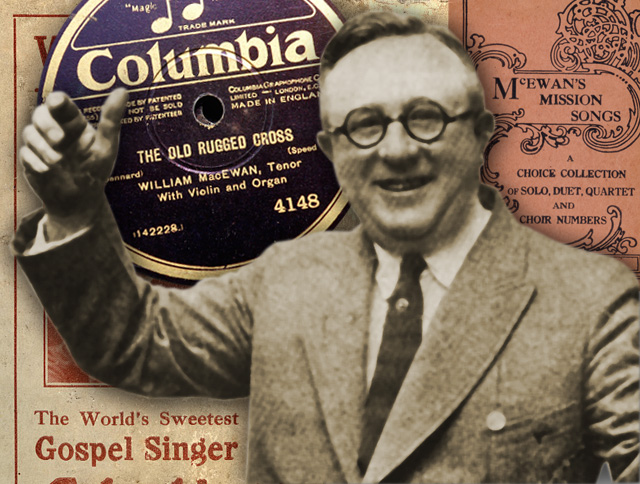
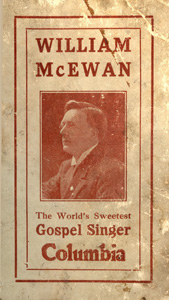
William MacEwan of Glasgow and New York (1871–1943) ........ 'The World's Sweetest Gospel Singer'.
I am gradually refreshing a series of blog posts from 2011 to have their own dedicated blog which you can find here.
Tuesday, December 29, 2015
James Cleland and the Snake Experiment
In 1831, James Dowsett Rose Cleland (1767-1852) of Rathgael near Bangor decided to test the legend that St Patrick had not only driven the snakes from Ireland, but that he had also made the island uninhabitable by them. Cleland went to Covent Garden in London, bought six snakes (natrix torquata), and brought them home where he released them in his own garden.
Within a week one of them was killed six miles away at Milecross near Kiltonga outside Newtownards, causing great excitement and concern among the local population. It was taken to the naturalist Dr James L Drummond (1753-1853), Professor of Anatomy at Belfast Inst, who was horrified by the discovery of a snake in Ireland. One minister preached on the subject, suspecting the end of the world was nigh, and another linked the snake’s appearance to cholera.
Rewards were offered for the other snakes - three were soon killed fairly close to Rathgael, but the whereabouts of the other two was unknown. However, according to the Belfast News Letter of 9 December 1831, Cleland gave two specimen snakes to the Belfast Natural History Society.
The story has been printed in many publications ever since, most of which are based upon a detailed account in Edinburgh author Robert Chambers' (1802–71) famous volume Book of Days which was published in 1864. The writer of this account said that he had ‘resided in that part of the country at the time, well remembers the wild rumours' – locals are said to have called the dead snake a ‘rale living sarpint’. Another of his publications - Chambers’ Edinburgh Journal, regularly published stories from Irish history.
Here’s the relevant article from Book Of Days, which interestingly also contains many of the other Scottish traditions of St Patrick which I have mentioned here often before.
In 1847 Chambers wrote this of a visit to Dublin:
When lately in Ireland, I was, like all other tourists, struck with, and interested in, two things the opposite of each other — one, the surprising number of objects of antiquity, indicating a former age of wealth, literature, and refinement ; the other, the absence of all present moral vigour, with a wretchedness the very nearest thing to an entire negation of property and comfort. You see the remains of ecclesiastical edifices with the most gorgeous carvings ; stone crosses lying prone in the dust, any one of which would be the marvel of an English county ; and in museums you are shown books of vellum, in the ancient Irish character, bound in gold and silver, and ornamented with precious stones, which are said to be worth, in the present day, thousands of pounds.
In the collection of the Royal Irish Academy I was shown a copy of the gospels which had belonged to St Patrick ; an almost coal-black little vellum book, that could not be a day less than fourteen hundred years old ; and also a similarly antique copy of the Psalms of David, which had been the property of the pious Columba, who went as an apostle to Scotland about the year 563. The eventful history of these literary relics was of course duly verified, and afforded, among other things, room for much melancholy reflection.
Tuesday, December 15, 2015
Glenfield & Kennedy (Kilmarnock) water pumps
I've been noticing these over the past while. Here on the Ards Peninsula two are in Cloughey (pink and brown) and one in Millisle (green). There's a more elaborate one in St Johnstown in Donegal with a lion's head. Glenfield & Kennedy were a huge firm in Kilmarnock in Ayrshire, selling products around the world. It seems that they were suppliers to local authorities in Ulster, and Ireland as a whole.
Tuesday, December 08, 2015
The Ulster Irish Society of New York (founded 1926)
Founded in 1926, the Ulster Irish Society of New York seems to have been an influential group in its day, hosting swish annual banquets at top hotels in New York, with guest speakers such as pioneer aviator Amelia Earhart and Eleanor Roosevelt. It is interesting that there was a time when 'Ulsterness' was chic and fashionable, even in the New York City of the 'Roaring Twenties'.
At the top table in the pic above is typography legend, Illinois-born Frederic William Goudy who presumably must have been of Ulster ancestry. His family surname was originally spelled Gowdy but this was changed in 1883, his parents were John Fleming Goudy and Amanda Truesdale.
One of the big Gowdy histories, published in the USA in 1919, says this –
'… The pioneer ancestors of this branch of the Gowdey-Goudey family, like so many other early American settlers bearing the name, represented the sturdy Presbyterian stock who carried their "Articles of Faith" with them when they left the vales of Ayrshire in Scotland for their new home in the "Ards" on the Peninsular in the County of Down in Ireland; and the elements of moral and religious character conspicuous in unnumbered generations of their fore-fathers were cherished by them and transmitted as a priceless heritage to their posterity …' –source here
As for Amelia Earhart, here's what she said in her 1933 address to the Society, who presented her with a roll of linen woven from flax from the field she landed in, near Londonderry –
" I never had greater hospitality than was shown me in Ireland, " concluded Miss Earhart. " I am going back some time, and I am going to take Mr. Putnam (her husband) with me to see if it is as beautiful as it looked to me on landing. And now I am going to tell you something which may be of interest to you - my mother's father's parents came from Londonderry."
Wednesday, December 02, 2015
The first church building in Portavogie
The Fishermen's Hall, or Fishermen's Mission Hall, was built in late 1886 and opened in 1887, on a site on the Warnock's Road. I remember being in it on at least one occasion in the 1970s. A 'tin tabernacle', it is long-gone, finally demolished in the 1980s. One of the leading men in its establishment was Thomas Shaw, an Elder of Kircubbin Presbyterian Church. A newspaper advert in 1886 said that –
"… it is intended that the Building will be used for Weekly Services, Prayer Meetings, Sunday Schools, and Bible Classes, all to be conducted on Evangelical Principles. Subscriptions from those interested in the moral and spiritual welfare of our Fishermen, and who may desire to show practical sympathy with this praiseworthy effort, sholl be thankfully acknowledged ...".
For 40 years this was the only evangelistic outreach in the village, apart from the occasional event in the Orange Hall, of which an 1885 newspaper article said "… in addition to its legitimate uses, serves admirably for either a religious service or a 'whisky ball' ...". Perhaps this accelerated the desire for a distinct place of worship!
The village had flourished in the mid 1800s. In the 1850s it was said that there was only a few houses, but by 1885 there were nearly 300, and a population of around 1000 people with 400 men employed at the fishing in the summer herring season.Portavogie Presbyterian Church, and the non-denominational People's Hall, both opened in Portavogie in 1926.
As far as the wider locality is concerned, at nearby Butterlump a Gospel Hall had been founded - also in the 1880s - by James Patton, a watchmaker of Newtownards following a trip he had made to Stranraer to meet a preacher named John Walbran. In later years my grandfather was involved at Butterlump. Cloughey Presbyterian Church dates from 1841, and St Andrews Parish Church at Ballyeasborough from 1850.
Tuesday, November 24, 2015
'The Truth About Ulster' - Frank Frankfort Moore (1914)
Frank Frankfort Moore (1855–1931) was born to Presbyterian parents in Limerick. He was a brother-in-law of Bram Stoker, and was a prolific writer. He was educated at Inst in Belfast and became a journalist with the Belfast News Letter. This volume, now online, has some superb observations about Ulster life - some scathing, but mostly packed with truth. Here's a gem of an extract:
'… We reckoned it no feat to cross that narrow channel, and to watch the Galloway hills, already seen to be green by anyone looking out from Donaghadee or Ballywalter, become clearer and brighter with every hour's sailing, until the beautiful undulations of the shores of Lough Ryan were on each side of us, and we could run our boat comfortably into a natural harbour with a sandy ground to drop our anchor into. And when we hailed one of the fishermen outside his own cottage, we found him and his people speaking exactly the same dialect as was spoken on the Irish coast which we had left a few hours before; for the Scotch of the County Down coast from Bangor to Portaferry, is the Scotch of the coast of Galloway …'
Saturday, October 31, 2015
Tuesday, October 27, 2015
Francis Boyle and the "ladies of the night" of Donaghadee – Hornbook's Ghaist.
(Fully understood, Ulster-Scots poetry isn't just a source of old words and vocabulary. The poems take the reader to a different time and place, to better appreciate how society functioned in days gone by. With thanks to Fiona McDonald for permission to reproduce this 2009 post from her blog).
Here's a poem written by Francis Boyle (c1730–post 1811) of Gransha County Down from his 1811 volume Miscellaneous Poems. His was the Gransha near Dundonald rather than the one near Bangor. Although it is often said that Ulster-Scots writers merely imitated the works of Robert Burns, many of Boyle's poems were written before Burns work was published, although this one does appear to have been influenced by Burns.
Interestingly, Robert Burns wrote 'Death and Dr Hornbook' in 1785 as a satire about John Wilson, the son of Glasgow weaver who initially came to teach at Tarbolton and later kept a shop where he also sold drugs and gave out medical advice. A 'hornbook' was a sheet of paper with basic learning tools such as the alphabet, numerals and the Lord's Prayer and this would have been mounted on wood and covered by a protective plate of transparent horn. Burns wrote his poem after hearing Wilson going on about his medical knowledge at the Tarbolton Masonic Lodge. Here's Boyle's poem:
HORNBOOK'S GHAIST
It happen't ance in Donaghadee,
No' monie perches frae the kee,
A gentleman I chanc't to see,
'Mang ither foks,
Wha deign't to talk a while wi' me,
An' sklent his jokes.
He saw that I was auld an' gray,
An' had but little for to say,
My garb was neither mean nor gay,
Just kintra weed,
An' as it was a frosty day,
Had tie't my head.
He took me for some kintra clown,
Wha liv't far distant frae the town;
He'll rue his folly I'll be boun',
To slight my leuk;
I'll spread his fame the kintra roun',
In my new beuk.
I hear he has attain't some skill,
To wait on women when they're ill,
An can prescribe sic dose or pill,
As mak's them worse;
An' braid receipts for them he'll fill,
To swall his purse.
But yet mair famous for his cures
O' batter't bawds, an' pockie whores,
While here an' there he taks his tours,
'Mang brothel-houses;
He sudna scorn my mental pow'rs,
Nor slight the Muses.
These sportin' Does, like Mrs. Clarke,
That win their wages i' the dark,
An' warm their logies wi' their wark,
Which staps their water
They maun gie Hornbook monie a mark
To mak' them better.
Young Tarry-breeks is come ashore,
Thro' storms an' tempests that did roar -
Revisits now his paramour,
The sportin' maid,
An' swears she's sprightly, aft an' fore,
An' fit for trade.
Some folk will say he's but a quack,
But that maun be a great mistak';
He cur't young Jamie, Wull an' Jack,
An' teuk their fees,
An' mim-mouth't Meg, the ridden hack,
O' her disease.
Nae Hornbook bred in shire o' Ayr,
Wi' our new doctor can compare;
My lads, jog on, an' never spare
To warm their tail;
Twa or three days in Hornbook's care,
Will mak' thee hale.
As Jock does live at the sea-side,
He sud bathe aften in the tide;
To brace his nerves, an' clean his hide,
In the saut water;
Perhaps this might allay his pride,
An' stap his clatter.
Monday, October 19, 2015
Brilliant political advertising - SNP 2015
A friend showed me this the other day, I hadn't seen it earlier this year around the time of the UK General Election. Absolutely superb.
Braidstane Castle, Ayrshire, home of the Ulster Montgomeries
Braidstane Castle (detailed Wikipedia entry here), nowadays Anglicised in neighbouring farms as 'Broadstone', is long-gone. Dismantled in the 1700s, all that remains now is a stone boundary wall. It's just a short drive from Gateside near Beith in north Ayrshire, along Reek Street, to a bend in the road that normally wouldnt cause a second glance unless you knew what was once there. For here, Con O'Neill and Hugh Montgomery lived it up for three days in 1604, celebrating Con's escape and impending Royal pardon from Montgomery's friend King James VI & I, and also celebrating vast amounts of County Down land which Montgomery was going to receive in return.
Here it is, named as 'Braidstam' in Blaeu's map of 1665, not quite as big as the neighbouring Montgomery castles of Hessilhead and Giffen.
Here it is again, on Andrew Armstrong's map of Ayrshire, circa 1775 (See here for full res version)
Somebody has recently marked the site on Google Maps (link here)
More to follow...
Saturday, October 17, 2015
George Best, Ulster-Scot.
Don't take my word for it. His father was famously a member of the Harland & Wolff Burns Club. Germaine Greer once wrote that "George was a genuinely hard man, but hardness results in fragility. His working-class Ulster-Scots upbringing afforded him no way of coming to terms with that fragility". He spent his latter years living near his family outside Portavogie, in a relatively new house built on ground my father used to own and where I used to gather both spuds and straw bales – exactly three fields from where I now live. We can see the gable end from our front step. Here he is, looking Burns-esque, resplendent in full tartan.
Thursday, October 08, 2015
Joe Rae at Donaghadee Montgomery stone
A week ago my friend Joe Rae called in on his annual road trip around Ireland. Joe and I got in touch many years ago through a shared appreciation of the song My Ain Countrie which was recorded by William MacEwan in 1911, and we have stayed in touch ever since. Joe lives in the hills above Beith in North Ayrshire. On previous visits I have made to see him, and his late wife Jean, he has taken me to the site of Braidstane Castle, which was the home of Sir Hugh Montgomery back in 1606, and also to the ancestral home of Montgomery's great rival, Sir James Hamilton, in the Main Street of the village of Dunlop which is also in Ayrshire. I took Joe on a wee jaunt around the Ards - up to Ballywalter, then to Donaghadee (specifically the Parish Church with the Montgomery memorial stone over the doorway), and then to Grey Abbey. Later that evening we went to the unveiling of a newly-restored cow tail pump in Greyabbey village, where I was pleased to introduce Joe to various Ards folk including Bill Montgomery, the head of the Ulster Montgomeries and a collateral descendant of the original Braidstane Montgomeries. The photo above could be captioned as: Joe Rae from near Montgomery's Braidstane visiting Donaghadee to see a Montgomery of Braidstane stane.
Monday, October 05, 2015
Saturday, October 03, 2015
James McHenry's inspirational aunt
Maligning and ignoring Ulster-Scots is nothing new. This is from novelist James McHenry's introduction to his 1798 Rebellion book O'Halloran, regarding the aunt who funded him to write it –
In an excellent essay entitled 'Irish and American Frontiers in the Novels of James McHenry' by Stephen Dornan, from the Journal of Irish and Scottish Studies (Volume 3 Issue 1), comes this observation on the 'three stranded' cultural nature of Ulster –'…amidst the multitude of volumes which she had perused on these subjects, she was surprised to find none that gave anything like an accurate account of the people among whom she had spent her whole existence … she was much chagrined with the carelessness with which even professed travellers through Ireland have uniformly mentioned its northern province. Some, she would say, seem to treat the people of Ulster as altogether beneath their notice; others take delight in making them the objects of misrepresentation and slander; while none manifest for them that sympathy and respect, to which, from their spirit of enterprise and industry, they are assuredly entitled…'
'… McHenry saw Irish society not in terms of a binary between Protestant and Catholic, but rather as divided in triangular terms between Anglicans, Roman Catholics and dissenters. He was annoyed at Owenson’s wilful exclusion of the dissenting element from the moment of resolution in The Wild Irish Girl, in which Anglican ascendancy Ireland is symbolically united and reconciled to ancient Catholic Gaelic Ireland through the marriage of Horatio and Glorvina. The Anglican and Catholic traditions are symbolically reconciled, whilst the Presbyterian tradition is acknowledged by Owenson, but ultimately excluded …' – Published by the AHRC Centre for Irish and Scottish Studies, University of Aberdeen - online here.Over 200 years later, these themes sadly persist.
Thursday, September 24, 2015
Henry A Chambers (1841–1925) - Confederate soldier, Tennessee Politician, and Scotch-Irish historian
(The more you look the more you see, the more you dig the more you find. In looking for something else I came across this man recently.)
Captain Henry A Chambers (1841–1925) was born in Iridell County, North Carolina, which is said to have been nicknamed 'Scotch-Iridell" due to it being almost entirely Scotch-Irish in population. He attended Davidson College, joined the Confederate Army in May 1861 and was wounded at the Battle of Five Forks in Virginia in 1865. After the war he settled in Tennessee, becoming an Attorney and a member of the Tennessee House of Representatives. He was also a senior Freemason in the Grand Lodge of Tennessee (whose website features the portrait shown below)
His papers are held at the University of North Carolina, including a family history. Of the Chambers who settled there in 1754, having moved south from Pennsylvania, he wrote that –
"... They were all probably descendants of the James Chambers whose name appears on the rent roll of the Scotch farmers who settled in Ireland under the auspices of Hamilton & Montgomery in the reign of King James I of England (VI of Scotland) ..."
– from the Statesville Sentinel, 31 Dec 1914
The first Chambers in his line reached Philadelphia in 1726, a group of four brothers who had sailed from County Antrim. Chambers contributed to a huge family history compiled by William D Chambers in 1925, all of which is now online here. He said that Iridell County was full of:
"... families bearing such names of Scotch extraction as Freeland, Fleming, McHney, Chambers, Summers, Steelen, Murdock, Patterson, McNeely, Roseboro, Graham, Kerr, Irvin, Woods, Johnson, Hall and Ramsey. Most of them, whether church members or not, were of the Presbyterian or Calvinistic faith ..."
His papers include his Civil War diary, which shows his interest in reading and history even during army drills and training:
Monday, Sept. 28, 1863
Had company drill in the morning and battalion drill in the evening by Col. McAfee. After the evening drill, we had dress parade. A Rev. Mr. Rugland preached tonight. I was engaged in reading Macaulay’s History of England in my leisure time.Monday, Jan. 18, 1864
I was engaged during the forenoon in writing and in the afternoon in reading Macauley’s England. I have become deeply interested in this history. The iniquitous reign of James II is now drawing to a close and it is instructive and interesting to see what desperate measures he and his courtiers are resorting to...Tuesday, Jan. 19, 1864
I am becoming more and more interested in Macauley’s England. He groups his historical characters in such a way that his narrative excites something with the same interest that a well written novel produces. His reflections, his searching analysis of character, his felicity of style, all contribute to charm one with his history. I have today read his account of the influence and circumstances which induced Wm. Prince of Orange to interfere with the government of England and have arrived at the end of the 9th of the long chapter where James, after retreating before the prince and finding his friends and army deserting him, resolves to follow his wife and little son to France. Last night George W. Carr of my company got a sick leave of twenty days. This evening, Samuel S. Benson was sent to the hospital and we received orders permitting five enlisted men to be furloughed for every 100.
At the infamous battle site of Manassas he reported that there had been whiskey smuggling into the Confederate camp by Irish girls –
Thursday, Jan. 9, 1862
On this day we were on duty in the muddiest of the muddy places, Manassas Junction. It was cloudy all day –that and a thick fog rendered it almost impossible to distinguish objects more than twenty paces distant. This morning, we police confiscated some goods in the shape of two boxes filled with “fire water”. These boxes were being smuggled into camp by two of the “fair daughters of Ireland”.
In 1915 he serialised a 15-part 'History of the Scotch-Irish' for the Statesville Sentinel, a remarkably detailed account which drew heavily upon Charles A Hanna's (1863–1950) landmark two-volume set The Scotch-Irish, or, The Scot in North Britain, North Ireland and North America (1902).
We are Protestant
When you get your head out of the Northern Ireland goldfish bowl, where sectarian narratives are imposed upon pretty much everything, and where intra-Protestant divisions separate the churches, you forget the global power of the term, of what it stands for, of the simplicity of the faith.
Together For the Gospel is a biennial conference in the USA, where the leading minds (speakers and authors) get together on common ground – black, white, Asian, Latino. I am sure they have differences. But when they set those aside the outcome is powerful.
So what exactly did Jesus Christ achieve? Did He do it all? Or did He just do some, and now you have to do the rest? If we were capable of making ourselves right with God through our own efforts or religious observances, then, reverently speaking, Jesus Christ made a terrible mistake and wasted His time. Is your hope in Him, or in yourself?
Here's next year's T4G video as they lay the groundwork for the 2017 500th anniversary of Martin Luther's 95 Theses.
T4G 2016: We Are Protestant from Together for the Gospel (T4G) on Vimeo.
Sunday, September 20, 2015
Robert Dinsmoor "Incidental Poems accompanied with Letters" (1828) – an Ulster-Scots-American Poet
In Ulster Province, Erin's northern strand
Five shiploads joined to leave that far off land.
They had their ministers to pray and preach
These twenty families embarked in each.
Here I would note and have it understood,
Those emigrants were not Hibernian blood,
But sturdy Scotsmen true, whose fathers fled
From Argyllshire, where protestants had bled
In days of Stuart Charles and James second
Where persecution was a virtue reckoned,
They found shelter on the Irish shore
In Ulster, not a century before
Four of these ships at Boston harbor landed;
The fifth, by chance at Casco Bay was stranded…
– from 'Jamie Cochran, the Indian Captive' (the opening poem in the 1898 edition)
Some years ago I was fortunate enough to acquire a copy of Incidental Poems by Robert Dinsmoor (1757–1836), the 'Rustic Bard' of New Hampshire, which was printed in Haverhill, Massachussetts in 1828. Dinsmoor reveals at the start of the book in a chapter entitled 'Life of the Author written by himself' that his ancestry can be traced to Achenmead (originally thought to have been near Peebles, but also said to be north of Kilwinning in Ayrshire) in Scotland, then to Ballywattick near Ballymoney in County Antrim, and then to Londonderry New Hampshire - and so it's no surprise that he uses a fair amount of Scots / Ulster-Scots in his poetry. The volume includes references to Robert Burns, Belfast-born Elizabeth Hamilton and Hector MacNeill. Songs appear which are written to tunes such as 'Boyne Water' and 'Scots Wha Hae'.
The book also includes a poem by his uncle, Samuel Dinsmoor, which is also in Scots / Ulster-Scots. Standouts in the collection are 'The Sparrow', 'Skip's Last Advice' and the reproduction of Elizabeth Hamilton's 'My Ain Fireside' definitely warms the cockles.
In 2012 the Ulster Historical Foundation published a new edition entitled Robert Dinsmoor's Scotch-Irish Poems, introduced by Frank Ferguson and Alister McReynolds. I get a wee plug in the Acknowledgements for having loaned my original edition to the project. Click here to order a copy.
Lots of Dinsmoor material is now easily available online:
• Incidental Poems(1828) on GoogleBooks here
• Poems of Robert Dinsmoor the Rustic Bard (1898) on Archive.org here
• The Earliest History and Genealogy of the Dinsmore-Dinsmoor Family (1891) on Archive.org here
• The History of Windham in New Hampshire, a Scotch Settlement - Supplement (1892) on Archive.org here
• The History of Windham in New Hampshire, a Scotch Settlement (1892) on Archive.org here
• Among the Scotch-Irish, with history of the Dinsmoor family (1891) on Archive.org here
• Article about Dinsmoor, by Prof Michael Montgomery, on UlsterScotsAcademy.com
Friday, September 18, 2015
"Poems chiefly in the Scottish dialect, originally written under the signature of the Scots-Irishman"- David Bruce, Washington DC, 1801
The song on page 39 – To All Scots-Irishmen, Citizens of America - blends William of Orange, William Wallace and George Washington.
Thursday, September 10, 2015
Monday, September 07, 2015
Wednesday, September 02, 2015
Doug Wilson & the Jenny Geddes Band - "Hold Your Peace"
Thanks to Robert for this. Douglas Wilson is an author and a friend/sparring partner of the late Christopher Hitchens.
Tuesday, September 01, 2015
Finding the McCains: A Scots Irish Odyssey
I've been meaning to highlight this book for some time. There is a Finding the McCains group on Facebook. Published in December 2014 and written by Mississippi-based Barry McCain, a long-time reader of this blog, it is available on Amazon in both paperback and Kindle formats. The Amazon summary reads as follows:
'Finding the McCains,' is an account of one Mississippi McCain’s 40 year odyssey to find his family in Ireland. Senator John McCain and his cousin, novelist Elizabeth Spencer, both include a short history of the Mississippi McCain family in their respective memoirs 'Faith of our Fathers' and 'Landscapes of the Heart.' This history is a romantic tale of Highland Scots who supported Mary Queen of Scots and who fled to Ireland after her downfall in 1568. The search for the McCains became a mystery story with clues, false turns, many adventures, and then ultimate success through Y chromosome DNA testing. In 2008 the McCains were reunited with their family that remained in Ireland, after 289 years of separation. The McCain history includes people and events familiar to readers of Irish and Scottish history; Redshanks, Iníon Dubh, Mary Queen of Scots, the Earls of Argyll, the Ulster Migration, and the Scots-Irish, are all part of this family’s story. Faint memories of this past were told for generations in Mississippi and as the research progressed the facts behind these memories were uncovered. Another theme in the book is the Scots-Irish. Contemporary histories about the Scots-Irish present stereotyped and romanticized accounts of this dynamic group. 'Finding the McCains' reveals a more complex history and shows the cultural conflation common in Scots-Irish popular history. 'Finding the McCains' is also a genetic genealogy how-to guide for people of Irish and Scottish ancestry.
Friday, August 28, 2015
Niall MacGinnis as Martin Luther - "this is no sudden doubt, but a growing certainty"
Niall MacGinnis (1913–1977) was Dublin-born, educated at Stonyhurst College (a Jesuit school) in Lancashire and then at Trinity College Dublin. In this 1953 portrayal of Martin Luther's life, MacGinnis does a fine job in the lead role - the movie was nominated for two Oscars. Here is his Wikipedia entry. Interestingly for Northern Ireland readers, MacGinnis had played fictional IRA leader Terence Elliott in the 1936 movie Ourselves Alone (which was directed by Belfast man Brian Desmond Hurst). MacGinnis later served in WW2 as a Royal Navy surgeon.
Go to 30 minutes:– "…and when I found it, it was as if the gates of heaven were opened to me … Christ, man only needs Jesus Christ …"
UPDATE: Thanks to Jack for letting me know that Brian Desmond Hurst was originally named Hans Hurst, he signed the Ulster Covenant at Belfast City Hall in 1912. During the Great War he changed his name to Brian Desmond, perhaps to avoid being thought of as German.Wednesday, August 26, 2015
Is Robert the Bruce's 1310 sword in an attic in Fermanagh?
Above: an Edwarded Prins Anglie sword, from the collection of The Fitzwilliam Museum, Cambridge.
In 1696, William Montgomery, author/compiler of The Montgomery Manuscripts, was visiting his relative Hugh Montgomery at Derrygonnelly in County Fermanagh. The house had previously belonged to Sir John Dunbar, the high sheriff of County Fermanagh, who had settled in the county in 1615. Hugh Montgomery (1651–1722) was a captain in the army of William III, and had married Dunbar's granddaughter and heiress, Katherine. One of Sir John Dunbar's ancestors, Patrick III, Earl of Dunbar (1213–1289) had married Christiana Bruce (1246–1275), aunt of King Robert the Bruce. So the Dunbars were Scottish aristocracy with a Bruce connection. Here's where it gets interesting… During his three night visit in 1696, William Montgomery wrote that he had seen:
"… a rarity att that house, to witt, a two-edged sword of excellent metall (which this Hugh never caused to be made) … I am of the opinion that no smith in Ireland can forge soe good a blade … the sword is inscribed on ye right hand side of ye blade thus – Robert Bruscius, Scotorus Rex, 1310, and on ye reverse side Pro Christo et Patria D:ER …"In the mid 1800s a search for the sword was carried out but with no success, and in 1867 a letter appeared in The Scotsman and The Northern Whig, appealing for its whereabouts. In 1899, the sword surfaced and was brought to the Society of Antiquaries in London, but they cast doubt on its authenticity. Charles Alexander, the Baron de Cosson, and a Fellow of the Society, thought that the sword wasn't old enough to be from the time of Bruce. He thought it closely resembled 17th century swords inscribed by Edwardus Prins Anglie. I can't find any other record of the sword since then. I think that folklore is often more valuable that verifiable history, in that folklore reveals what people want to believe and is an insight into their values and aspirations. Forgery or not, presumably the sword is out there somewhere and whoever owns it today is the custodian of an important Ulster-Scots artefact.