
This ad is from the US magazine 'Holiday', for the British Travel Association. The main image is of Greencastle, County Down, on the shore of Carlingford Lough. It's an area with both Viking and Anglo-Norman heritage. It was captured by Edward Bruce in 1316, and is also recorded that his brother King Robert the Bruce of Scotland offered to broker a peace agreement with the King of England - with Greencastle as the proposed venue for the negotiations - around 1326. Edward Bruce was of course killed nearby in a battle in 1318 and his body (or bits of it at least) are buried in an ancient graveyard there.
Greencastle was used as an English garrison in the late Elizabethan period in the 1590s - and it's still an impressive building and location today. Northern Ireland is seldom, if ever, used to promote the wider 'nation' (however you choose to define that), we tend to get pushed to the periphery. How different it was 50 odd years ago. I still believe that our multi-cultural mix makes Northern Ireland one of the most interesting heritage locations in the UK / Ireland. My English relatives were surprised to see so many Anglo-Norman castles in our small area of east Down on a visit last year.
I was fishing for tope on Carlingford just over a year ago with some friends and took the photos below from the boat.
Below: The view from the Irish Sea into the mouth of Carlingford Lough - Co Louth to the left and Co Down to the right.There is some talk about building a bridge across the Lough.
Thursday, October 17, 2013
When Northern Ireland spoke for Britain - a 1956 advertisement for the British Travel Association


Monday, October 14, 2013
Robert Burns Centenary Celebrations - the Music Hall and the Corn Exchange, Belfast - 25 January 1859
At Belfast Music Hall a festival was held (and in other towns in Ireland too). Professor George Lillie Craik (who just 2 years later published 'History of English Literature and the English Language') of Queens College gave a rousing speech which included these remarks:
'... this is not Edinburgh or Glasgow, but Belfast. It is true that Burns belongs to Scotland, and not to Ireland; but besides that, many of us now present are Scotchmen by birth, and can only claim the honour of being Irish by adoption, or by sufferance; it might also be made a matter of question whether this Ulster of ours be not really more a part of Scotland than a part of Ireland ... we have come over and set up another Scotland here - an Irish or Little Scotland, as it may be called. We have made this Province of Ulster - this Black North - half Scotch, or more than half Scotch, in almost everything – in blood, in language, in religion, even in mind and character ...'
Hugh McCall of Lisburn said that '... not even in his own Ayrshire is the poetry of Burns held in higher estimation than it is in the counties of Down and Antrim ... Had the poet Burns, when on his deathbed in Dumfries, been able to look through the vista of years, and see that, at the end of a century from the date of his birth, the people of Belfast would have met in such glorious assembly as I see in this room, it would have given comfort and no doubt considerable happiness ...'
Burns' daughter and granddaughter were among the crowd that night. At the same time as the Music Hall banquet, a soiree was held at the Corn Exchange (pictured above) with about 400 in attendance 'composed principally of the more respectable of the working orders', with prominent figures such as Rev Dr M'Cosh, Rev Hugh Hanna, Rev George Cron, Rev Mackey and Mr John Ritchie all in attendance. The Oldpark Band were there and played a selection of Burns' airs throughout the night, and Ritchie sang a rendition of 'Rantin Rovin Robin'.
Detailed accounts of the events in both places are readily available.

Friday, October 11, 2013
Belfast-Glasgow Wine Jug
One from the collection which came up in conversation the other day, probably made for a firm called John Grant Wines & Foods Ltd who owned various hotels and restaurants on both sides of the water. The curved message reads 'A meal without wine is like a day without sunshine'; the four venues are the Grand Central in Belfast, Rogano Restaurant & Sea Food Bar in Glasgow, the Royal Restaurant in Glasgow and the Buchanan Arms Hotel in Drymen, north of Glasgow. Made by J Abrahams & Sons Ltd, no date marked on it but must be around 1927 when Grant took over the Grand Central. It was demolished in the 1990s and CastleCourt shopping mall is on the original site. See article here on CultureNorthernIreland.org
There is a similar example online here.


Thursday, October 10, 2013
George Francis Savage Armstrong (1845–1906)
Some of you will know how much I enjoy this man's work (see this previous post) both his poetry, some of which is Ulster-Scots, and also his epic family histories. I was pleased to help Rosemary Raughter from County Wicklow earlier this year who has published this online article about his time in Wicklow. Over the summer I went looking for his grave up at Ardkeen Church - it is thought to be among the thick overgrowth below the ivy on the wall of the building. It has been described as a 'monumental altar-shaped tomb outside, and close to, the south wall of the ruined Church'.
He lived in his latter years at Strangford, in the house which overlooks the village, shown here just behind the old castle. A selection of his work, Poems National and International, was published in 1917 as a memorial to his eldest son, the Dublin-born Lieutenant-Colonel Francis Savage Nesbitt Savage-Armstrong, who was killed at Arras on 23rd April 1917 whilst serving with the Royal Warwickshire Regiment, aged 36.


Monday, October 07, 2013
Saturday, October 05, 2013
An Ulster-Scottish-Viking-Pictish artefact
Coming up for auction in England soon is this artefact. It had the following remarkable - truly multicultural - description:
8th-10th century AD. A Hiberno-Norse discoid weight with domed upper face with inset decorative panels comprising two quadrants with three spirals each, two quadrants with T-shaped keys executed in niello; between these interstitial bands of s-scrolled wire; central millefiori panel with chequerboard design; to the underside a discoid panel. 86 grams, 36 mm (1 1/2"). Found Northern Ireland, UK. The decoration of the quadrants is of Pictish workmanship. The same motifs are carved on the 8th century AD Hilton of Cadboll Stone (from Ross and Cromarty; now in the National Museum of Scotland) and elsewhere. These elements must be considered as loot or traded items which were embedded into a lead matrix in order to embellish the weight.
Auction listing is here.
(This artefact will get no media coverage as it's not political. And if a museum here purchases it, they will probably interpet it as merely geographically Irish thereby losing the nuanced and important cultural complexity)

Friday, October 04, 2013
Thursday, October 03, 2013
Sunday, September 29, 2013
George Wishart, the second Scottish martyr, 1546
Following on from the previous post about Patrick Hamilton, the second martyr in Scotland was George Wishart, who like Hamilton was burned at the stake in St Andrews. Earlier this year, the University of St Andrews hosted a conference to mark the 500th anniversary of Wishart's birth in 1513. Some details are online here and also here. Another link with recent blogs posts here is that Samuel Rutherford was buried at St Andrews. Here is a pic of his gravestone. There is an impressive martyrs monument in St Andrews.
Wednesday, September 25, 2013
Patrick Hamilton, the first Scottish martyr, 1528
I've been reading a bit about Patrick Hamilton again. He was a follower of Martin Luther and visited him in Germany. Hamilton's only known writings, later titled Patrick's Places - are online here. And here is a simple biography of the man from 1918. Luther once wrote that '... Virtually the whole of the scriptures and the understanding of the whole of theology–the entire Christian life, even–depends upon the true understanding of the law and the gospel...' . Patrick Hamilton wrote this:
A DISPUTATION BETWIXT THE LAW AND THE GOSPEL.
The Law saith,
Pay thy debt.
Thou art a sinner desperate.
And thou shalt die.
The Gospel saith,
Christ hath paid it.
Thy sins are forgiven thee.
Be of good comfort, thou shalt be saved.
The Law saith,
Make amends for thy sin.
The Father of Heaven is wrath with thee.
Where is thy righteousness, goodness, and satisfaction?
Thou art bound and obliged unto me, to the devil, and to hell.
The Gospel saith,
Christ hath made it for thee.
Christ hath pacified him with his blood.
Christ is thy righteousness, thy goodness, and satisfaction.
Christ hath delivered thee from them all.
Bad religion is a long list of rules for people try to keep. True religion is a long list of rules which demand perfection - and which you therefore know you can never keep - but which Someone else has kept on your behalf.
..................
King James V was king of Scotland when Patrick Hamilton was martyred on 29 February 1528 - Hamilton himself was of Royal descent through both of his parents. In fact, King James II of Scotland was a great-grandfather of both King James V and Patrick Hamilton too.
Over in Ayrshire, another branch of the family was led at this time by Archibald Hamilton of Raploch (1504-1559), who is described on a gravestone in Dunlop as being 'a servant of King James the Fift'. Photos below are from one of my visits to Dunlop.
There is no doubt that Archibald Hamilton would have been aware of the burning of his relative Patrick. Archibald died on the cusp of the Scottish Reformation and his son Hans Hamilton became the first Protestant (Presbyterian) minister of Dunlop, Ayrshire - and Hans' son would later become Sir James Hamilton, one of the 'Founding Fathers' of the Ulster-Scots.


Thursday, September 19, 2013
The Shackleton Banjo - 'A British-made Banjo for the People ' - 'Vital Mental Medicine'
Check it out on Kickstarter here.
Monday, September 16, 2013
Buy Ailsa Craig - now for sale at £1.5m
Even if you don't have the money (I'm going to have a rummage in the biscuit tin later just to see) the slideshow is worth looking at - click here.

Thursday, September 12, 2013
Samuel Rutherford's connection with the Ulster-Scots Montgomeries of County Down
In Edinburgh on 24 March 1640 the famous Scottish Presbyterian minister Samuel Rutherford married Joan/Jean Montgomery. She was the daughter of an Edinburgh merchant and widow of a Hugh Montgomery who is described as 'sometime of Balharie in the country of Doune'. Joan's surname had been Mackmath/MacMath/McMath before she married Montgomery. I have discovered the connection in a legal document during Cromwell's occupation of Scotland, written in Edinburgh on 26 July 1653, seemingly granting a large amount of formerly Montgomery lands in Wigtownshire to John Shaw of Greenock. The Shaws and Montgomeries were also intermarried; the Shaws too had land in Ulster, initially near Ganaway between Millisle and Ballywalter, and later at Ballygally Castle.
As I've blogged here before, Rutherford was a close associate of many of the early Ulster Presbyterian ministers such as John Livingstone, Robert Blair, Robert Cunningham and John MacLellan. In 1640 he, Livingstone and Maclellan were reported to the church authorities for encouraging people to organise communal Bible studies and prayer meetings in their homes at evening time, outwith the formal church services. Anyway, here is the text of the document -
...................
REGISTER OF THE GREAT SEAL of SCOTLAND (RMS) Under the Commonwealth (Cromwell).
Vol. X, pages 81 & 82, #164....
July 26 1653. (short extract)
The Keepers grant to Johne SHAW of Grenocke / Greenock (m. to.................?)
the 10 pound land of PORTRIE, (Wigtownshire, Scotland) viz : -
MARROK (Marroch / Marrock) with the castle, tower and fortalice of DUNSKEY situate thereupon ;
corn-mill of PORTRIE, with the 3 mills and mill-lands, etc. viz :-
10 pound land of PORTRIE,
5 pound land of KINGHILT,
3 merk land of DUNTOUNE,
port called PORTPATRICK ;
lands of MAROK and DUNTOUNE,
with several crofts of the said port ;
3 merk land of ENOCH ;
2 merk land of MEKEL PIGMANOCH;
3 merk land of CRAIGOCH ;
town or burgh of MONGRUMIE (MONTGOMERIE)
sea port of old called PORT PATRICK and now PORT MONGRUMIE,
with the whole anchorages, tolls, customs, and other privileges, &c., pertaining thereto, -
with the castles, towers, fortalices, manor-places, &c., of the foresaid lands,
all lying within the sheriffdom of WIGTON (Wigtownshire, Scotland) ; -
which lands pertained to HEW (MONTGOMERY), now Viscount of Airds / Ards,
his father, and were apprised from him on 1st August 1650,
at the instance of JOANE MONTGRUMIE (Montgomerie) alias MACKMATH,
relict (widow) of the deceased HEW MONTGRUMIE (Montgomery) sometime of BALHARIE in the country of Doune,(co.Down, N. Ireland) gentleman, and of (Rev.) SAMUELL RUTHFUIRD , professor of divinity, University of Saint Andrews,
now spouse of JOANE (widow of) MONTGRUMIE (Montgomerie) alias (nee) MACKMATH,
for his interest, which decree of apprising was assigned by the said JOANE MACKMATH
with consent of the said SAMUELL RUTHFUIRD to
Andrew WARDLAW, merchant burgess of Edinburgh,
by assignation dated 15th June 1653,
and was assigned by the said Andrew WARDLAW
to the said Johne SHAW
by translation dated 22nd July 1653 :-
With precept of sasine.
P.R. vii. 82.
...................
It's hard to believe that such a legal document would make a mistake on the identities of the people involved.
• This shows that the Hugh Montgomery who had been Joan's husband, was one of the Montgomeries of the Ards. That's the only reason she would have been involved in the issue involving Dunskey Castle and the surrounding lands.
• Depending upon how you read it, perhaps she was a hitherto-unknown third wife of Sir Hugh Montgomery, the first Viscount of the Great Ards? He died in 1636, his second wife Sara (nee Maxwell) died on 29 March 1636, and he himself died in May of the same year. But did he marry Jean MacMath within these last few weeks of his life?!
• This was Rutherford's second marriage. He had been minister of Anwoth near Dumfries from 1627-1638.
• Dunskey Castle near Portpatrick, a castle which had been acquired by the Montgomeries in the 1620s (this document in Latin states 8 Feb 1620 as the date Hugh Montgomery bought 'Doneskey')
• So where is 'Balharie'? One online source suggests 'Ballehenrie' or Ballyhenry between Comber and Newtownards, however there is a Ballyharry townland outside Newtownards on the road to Donaghadee - both areas were 100% Montgomery land back in the early 1600s.
Some online descriptions of the Rutherford/Montgomery marriage:
'... In 1640, after ten years as a widower, Samuel Rutherford married Jean McMath, a woman who was evidently fitted for such a husband. She was described as "a woman of great worth and piety". One person who knew them both said, "I never knew any among men exceed him, nor any among women exceed her". Before he went south to the Westminster Assembly, three children were born to them, but two of them died in infancy...'
'... but this marriage also was filled with much grief. Although his wife outlived him, he lost his children through untimely deaths. The first two died while he was away in London attending the Westminster Assembly; only one of the five more children given him lived. God, however, uses even a man's sorrow for the comfort of others. To one who lost a son he wrote: "Your Lord may gather His roses and shake His apples at what season of the year He pleaseth." And to another he wrote: "I know there is a true sorrow that is without tears; and I know there is a real sorrow that is beyond tears."...
'... In the year 1640, he married his second wife, Jean M'Math, "a woman," says one, "of such worth, that I never knew any among men exceed him, nor any among women exceed her. He who heard either of them pray or speak, might have learnt to bemoan his own ignorance. Oh how many times I have been convinced, by observing them, of the evil of unseriousness unto God, and unsavouriness in discourse." They had seven children; but only one survived the father, a little daughter, Agnes, who does not seem to have been a comfort to her godly mother ...'
..............
• Jean MacMath outlived Rutherford - he died in 1661 and was buried at St Andrews; she is said to have died on 16 May 1675 and was buried at Greyfriars in Edinburgh.
• Here is a letter Rutherford wrote to Jean's sister Agnes upon the death of one of her children (click here)
• Information about other 17th century McMaths in Edinburgh is available here, from The Abbotsford Club

Tuesday, September 10, 2013
Churches
In Northern Ireland recently there has been some high profile media coverage of disagreements in a church which are reported to partly be about musical forms. Whatever the specific issues, there can be little doubt that in some quarters there is a general decline in Bible knowledge and literacy, and I would suggest especially within the younger generation. Songbooks for Sunday school classes of 100 or so years ago (such as this one, edited by Robert Lowry and published in 1881) when looked at today, appear to be far more advanced and demanding than today's equivalents. There does appear to be a 'dumbing down' trend.
Here is a hymn by John Newton, the author of Amazing Grace, from the late 1700s. I suspect thatconceptually, never mind the particular vocabulary in places, it is alien to most today.
I asked the Lord that I might grow
In faith, and love, and every grace;
Might more of His salvation know,
And seek, more earnestly, His face.
’Twas He who taught me thus to pray,
And He, I trust, has answered prayer!
But it has been in such a way,
As almost drove me to despair.
I hoped that in some favoured hour,
At once He’d answer my request;
And by His love’s constraining pow’r,
Subdue my sins, and give me rest.
Instead of this, He made me feel
The hidden evils of my heart;
And let the angry pow’rs of hell
Assault my soul in every part.
Yea more, with His own hand He seemed
Intent to aggravate my woe;
Crossed all the fair designs I schemed,
Blasted my gourds, and laid me low.
Lord, why is this, I trembling cried,
Wilt thou pursue thy worm to death?
“’Tis in this way, the Lord replied,
I answer prayer for grace and faith.
These inward trials I employ,
From self, and pride, to set thee free;
And break thy schemes of earthly joy,
That thou may’st find thy all in Me.”
We live in the age of the txt msg, the 140 character tweet, an age where people increasingly don't read much of anything but rather passively consume video content. I don't have the answer but it is a growing problem.

Thursday, September 05, 2013
The Belfast outdoor wall light
A new range from John Lewis - so only available mail order in Northern Ireland. Said to have been inspired by the design of the lights on HMS Belfast. Click here. Also available from the Garden Trading Company website.


Tuesday, September 03, 2013
Jock Troup with a banjo-mandolin - and the Fishermen's Revival of the 1920s
Pictured above is the famous Scottish evangelist Jock Troup (1896 - 1954). Also a singer, he is known to have played the banjo-mandolin occasionally as accompaniment; his brother Harry was a well known fiddle player in the north of Scotland. A summary of Jock's life is available here. He spent much time in Ulster and I know of elderly folk who remember him fondly. At the bottom of this post are two photos of him at Bangor Christian Workers Society at Pickie Pool along the seafront, where the platform still stands today, I think it now says 'Christ Died for the Ungodly'.
These images have been grabbed from an excellent 48 minute documentary DVD of Jock Troup's life, produced by Gary Wilkinson, which is available on his website here for £10.99 plus £1.50 postage. I bought three copies a while back to share with other folk - it is highly recommended. A trailer for the DVD can be seen below:
• Revival Man, the Jock Troup Story is a detailed biography of the man and his work. Available here and on Amazon here.
• For information on Scottish revivals generally, this book, Glory in the Glen, will be of interest.
• I contributed some digitised recordings of Jock singing to the website RareTunes.org back in August 2010. Click here to listen to the recordings.
• See previous blog post here.


Friday, August 30, 2013
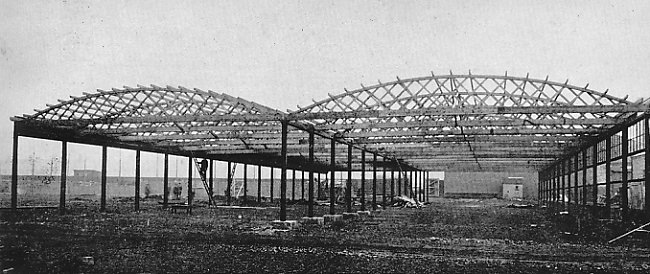
The Belfast Roof
Here is a feat of engineering which isn't talked about much. The Belfast Roof was an ingenious lattice system, developed around 1860. The trusses have a curved top, and could span huge distances with no need for any vertical supports like pillars inside. These meant that large open-plan buildings - like aircraft hangars - were much easier to build and work in. Aside from being structurally clever these were visually beautiful. Some pics below gathered up from various websites. It would be good to see these reintroduced to our local architecture.


Saturday, August 24, 2013
'Handed Down - Country Fiddling and Dancing in East and Central Down' by Nigel Boullier

Earlier this year I had the privilege to work with Nigel Boullier to put together a truly groundbreaking publication of his collection of over 30 years of music, photographs, stories, biographies and dances from the part of County Down where we both live. The outcome is the 544 page Handed Down - Country Fiddling and Dancing in East and Central Down, published by the Ulster Historical Foundation.
It covers over 200 years of living tradition, of community, of a world which predates and defies the 'two tribes' stereotypical approach to Ulster life. Nigel writes with authority, through years of study and research but because he is a fiddle player himself and is writing about his own folk, people who have influenced him throughout his life - and in turn of the people who influenced them, all the way back to the late 1700s.
Handed Down is a colossal achievement on many levels, succeeding in being both intimate and yet scholarly. Whilst my task was mainly to make it all fit within our page quota I hope that the design approach helps to get the story across. It contains 500 fiddle tunes, 30 dances and biographies of 300 fiddle players. It begins with a detailed overview of the origins of music and dance in County Down and, to me, a refreshing summary of the politics which have done such damage to folk tradition - on the one hand through appropriation by Irish Nationalism, and on the other hand just outright neglect and abandonment by Ulster Unionism. Traditional music is seen in our generation as the preserve of 'one community'. Handed Down shows that it is in fact a common inheritance, one which our ancestors truly shared.
As Nigel knows, at times it was a tough design process, but the painstaking effort that we both applied to it over many months has really paid off. We got on like a house on fire and a Waltons Mountain badge lives to tell the tale (that's an in-joke for Nigel!). Further photographs to be posted soon.
Handed Down - Country Fiddling and Dancing in East and Central Down is available here priced at £24.99.
Thursday, August 22, 2013
Wednesday, August 21, 2013
Glenfield & Kennedy Ltd, Kilmarnock (photographed today at the Thompson Pump House, Belfast)
You can find out more about the company's history at FutureMuseum.co.uk (click here)

Thursday, August 15, 2013
Moody and Sankey in Dublin, 1874
The two great American revivalists - DL Moody the preacher, and Ira D Sankey the song leader (who was of Scotch-Irish descent) - visited Britain in 1874. They arrived at Belfast on Sunday 6 September 1874 and preached to thousands of people until the following Sunday when they headed for Londonderry. From 24 October - 29 November they were in Dublin, again preaching to thousands every day. An account of their campaign in Dublin, printed in The Nation - said this:
'... Irish Catholics desire to see Protestants deeply imbued with religious feeling, rather than tinged with rationalism and infidelity; as long as the religious services of our Protestant neighbours are honestly directed to quickening religious thought in their own body, without offering aggressive or intentional insult to us, it is our duty to pay homage of our respect to their conscientious convictions; in a word do as we would be done by ...'
Remarking on this, a later author wrote '... it would surely be a bright and blessed day for our country, if this spirit of mutual respect and toleration were everywhere honestly acted out among us. Mr Moody never makes controversial reference to others. His success in attracting the favourable attention of our brethren of a different faith has been unexampled in the history of our city... men are not addressed as by their particular Church, but as sinners ...'

Wednesday, August 14, 2013
Sunday, August 11, 2013
Singing the Psalms in Prison
"... The dispute about Psalm-singing has broken out in an entirely unexpected quarter - an Irish prison. Some of the "Scotch-Irish" convicts have recently petitioned the chaplain not to use hymns in the prison service, but to use the Psalms, as the latter were inspired and the former were not. Perhaps if the criminals had shown the same degree of reverence for inspired writings before their incarceration, they would have saved themselves from much trouble and the country much expense ...'
- from the New York Times, 29 August 1869
Wednesday, August 07, 2013

Friday, August 02, 2013
Breakfast Ulster-Scots style
I was told this story many years ago. A big dour hefty man from Portavogie, John Thompson, married a thin timid wee woman called Maggie, probably some time in the 1950s. They moved into a cottage at the end of our road, at what was once a 'clachan' called Butterlump. On the day after the wedding, Maggie said to John:
"Whit way wud ye like yer egg this mornin John?"
Unimpressed, John said:
"Hmph. Alang wi anither yin".

Thursday, July 18, 2013
Animal cruelty
As I went up tae a wee hoose farm
A wee bark cam oot an dugged at me
I lifted my shouther over ma stick
An gien the wee dug such a lug on the lick
An made its water ee
(sent to me by Samuel, Carrowdore)
Monday, July 08, 2013
Joseph Braddell & Son, Belfast; manufacturers of breech loading shotguns, rifles & pistols. Established 1811
Saw this beautiful old label recently. Location of the shop? - next door to The Ulster Club - must have been a well-known venue in its day.

Thursday, June 27, 2013
Robert Wallace Murray - Confederate Army veteran, Belfast entrepreneur and philanthropist & resident of Newcastle, County Down.
Robert Wallace Murray was born in Jerusalem, Virginia, on February 9th 1836 (in 1888 the town's name was changed to Courtland). He was educated at home by his father, Dr Robert Murray, who had been born somewhere in Ireland, and who had been a classical scholar. The family lived in a large historic building called Elm Grove which Dr Murray bought in 1832, where he set up a school for local children. One of the pupils was William Walter White (1842-1918) a minister's son who later joined the Confederate Army (see biography here).
On the outbreak of the American Civil War, aged 25, Robert Wallace Murray joined General Robert E. Lee's regiment of the Confederate Army and is said to have 'participated in the brilliant dashes which made the Southern Commander famous in the earlier stages of the war.' (The National Park Service website records a Private Robert W Murray who served in the G Company of the 6th Regiment of the Virginia Infantry which had been raised in Norfolk, Virginia in May 1861. One of the regiment's field officers was Colonel William Mahone who like Murray also came from Jerusalem).
After the War Murray moved to Warrington in Lancashire and then to Ulster. He married Marion Workman at St John's Presbyterian Church, Newtownbreda on 7 June 1866. Marion died of typhoid fever on Boxing Day 1882, aged 37. Murray married again, on 19 March 1884, to Elizabeth Murray at Fisherwick Presbyterian Church.
He prospered in his new homeland and became a J.P. for County Antrim, Chairman of the famous Belfast tobacco firm Murray, Sons & Co, Honorary Secretary of the Royal Victoria Hospital, a Director of the Belfast Ropeworks Co. Ltd. and a member of the Belfast Harbour Board. He stood as a Liberal candidate in the election of 1886 for the constituency of East Belfast.
He penned a number of works - 'Modern Hindrances to Faith', 'General Lee' and 'Eighteen Months in the Confederate Army' a lecture which was published in 1877.
His home was Enniskeen, on the Bryansford Road near Newcastle - the 1901 Census records that he was 65 years old and his wife Elizabeth was 64. They had 4 female servants. The house is now the Enniskeen Country House Hotel (website here, including this overview of the history of the house).
He died on Christmas Eve of December 1904, leaving half of his estate to the London Missionary Society, and large bequests to Forster Green Consumptive Hospital (£75,000), the Belfast Society for Providing Nurses for the Sick Poor, and Belfast Hospital for Sick Children.
The former headquarters of Murray, Sons & Co. on Belfast's Sandy Row, has recently undergone a £5m refurbishment (shown below). I am sure someone out there can do further research into this fascinating man.
................
POSTSCRIPT 1 - The Virginian Pilot newspaper of Norfolk, Virginia reported on 20 May 1900 that Murray's brother was Rev James Murray, a noted Presbyterian minister and then pastor of Hampden-Sydney College. James was planning a trip to Belfast to visit Robert, after which he planned to go to the Paris Exposition. A third brother, Dr William W Murray was a pharmacist based in Suffolk, Virginia.
POSTSCRIPT 2 - This document contains the following details: '...In 1832 Oswin Ricks sold the property to Dr. Robert Murray, an Irish-born physician. Tradition states that Murray operated a school at Elm Grove at mid-century, a belief substantiated by the 1850 census which lists fourteen girls and two boys (in addition to the Murrays's own six children) residing at the house at that time. Murray sold the property to William W. Briggs in 1858. In 1887 Lucius Manry, father of the present owner, bought Elm Grove...'
Elm Grove is on the National Register of Historic Places and is shown below:
POSTSCRIPT 3 - before some looper froths at the mouth about the Confederates, and jumps to all sorts of bonkers conclusions, I am of course aware that there were men of Ulster descent on both sides of the Civil War / War Between the States / etc., including the Union Army's General Ulysses Simpson Grant whose ancestral home is near Ballygawley in County Tyrone. He went on to become US President. Grant visited the Harland & Wolff shipyard in Belfast in January 1879. It's easy to imagine Gustav Wolff greeting the former President, with fellow directors of related companies. I wonder if R.W. Murray J.P. was with the welcoming party, and if he revealed to Grant that just 15 years earlier they had been wartime adversaries? Or if he stood at the back quietly whistling 'Dixie'?


Tuesday, June 04, 2013
'he stabbed her in the heart and her heart's blood did flow...'
A new take on the famous Appalachian murder ballad 'Pretty Polly', by Vandaveer. Beautifully shot.
Thursday, April 11, 2013
Multicultural Ulster - introduction
Left: Detail from the Census of Ireland form, 1911.
What if everything you know is wrong? What if the stereotype of 'two tribes' in a state of constant antagonism in Ulster/Ireland is not true? What if it is in fact a relatively recent invention - and what if the actual story of Ulster / Ireland is of a truly multicultural place with thousands of years of comings and goings of different peoples and influences?
It has been said that there is no such thing as Irish history, just Irish mythology. The Census form here shows that 100 years ago efforts were made to avoid 'vague' terminology. Sadly this wisdom has not applied for the past few generations. People have been told that there are just two groups and that they belong to one or the other and never the twain shall meet or have met. But how would this place change for the better if everyone who has been fed that stereotype throughout their lives - and who as a result is boxed in to one of those 'two tribes' - had grown up understanding a bigger, broader and more accurate story?
Maybe rushing back to a selective interpretation of the 17th century, seeking justification to hate your neighbour, (as so many people ultimately seem to do) is a very unhealthy pastime and a very bad idea.
Over a series of posts to follow I am going to attempt to map out a complex, hopefully interesting, Alternative Ulster. The next post will begin with a family trip we made to Newgrange in the Boyne Valley in 2009 - a 5000 year old structure which is older than Stonehenge or the Pyramids...

Tuesday, April 09, 2013

Sunday, April 07, 2013
The Law v The Gospel (by Ralph Erskine, Dunfermline)

One for Sunday. The Bible shows us that the Law of God demands an impossibly high standard of perfection. No-one can achieve it - but many try to do so, and either end up:
a) filled with pride as they admire what they see as their 'successes' - as the poem above says it takes 'boasting' and 'feeds it to my bane', or
b) filled with despair when they experience repeated failure.
Jesus came and raised the bar. To paraphrase, He shocked his listeners one day by telling them 'here's a list of things that the Law says, if you do them, are sins. Well, even if you think about them that's sin too'. Only Jesus meets the perfect standard required the Law - and not only for Himself, but on behalf of all of the failures who trust in Him. I'm not a follower of Jesus because I am a 'good person' or as people in Northern Ireland often say 'good living'. I follow Him because I am a failure, rotten to the core in word, thought, deed and motive - but His perfection covers my failure completely. Ulsterman William McComb put it like this, inspired by these famous words from the Apostle Paul.
And so the Gospel, as the poem says, - 'yields me full relief'. And that relief, and gratitude, I hope is bringing about a change.
Saturday, April 06, 2013
National Tartan Day in the USA
Greetings to my US readers who are celebrating National Tartan Day today. The date of April 6th was chosen as this is the date of KIng Robert the Bruce's Declaration of Arbroath on 6 April 1320 - a document seen as the predecessor of the Scottish Covenants, the US Declaration of Independence, and therefore by default both the Ulster Covenant and the Women's Declaration of 1912. Of the 46 men who signed the Declaration of Arbroath, many had served under Edward (and Robert) Bruce during their campaign in Ulster/Ireland from 1315-1318. The list of signatories is available here.
See the Declaration of Arbroath online here.


Wednesday, April 03, 2013
Multicultural Ulster?
If you take the time to read the great historical volumes published in the 1800s, ie prior to the political turmoils of the various Home Rule crises which began in 1886, what you'll notice is the orthodox view was that Ulster as a province had been, throughout the centuries and millennia, a truly multicultural place. This is not understood today. Will post more here soon to develop this idea.