
Born in Canada, Bonar-Law was briefly British Prime Minister in the 1920s. During the anti-Home Rule campaign, as leader of the Conservative Party, he toured parts of Co Antrim and Co Down around Easter 1912. He and others, including Sir Edward Carson, arrived at Comber Square around 1pm on Easter Monday. During his speech to the gathered crowd, Bonar-Law pressed an Ulster-Scots button:
'...this is the first time I have visited Ireland on a political mission, and I can assure you that firmly I believe you are determined under no circumstances to allow yourselves to be driven out of the kingdom which your fathers have done so much to build and to sustain... I know Scotland well, and I believe that rather than submit to such a fate the Scottish people would face a second Bannockburn or a second Flodden Field. (Cheers.) And how can they expect that you will submit? All that is needed is to enable the people of England and Scotland to realise with what horror you regard the change which for a party purpose they are willing to force upon you. (Cheers.) Once they have realised that they will have realised also that the Unionists here are determined that the Union shall remain long after we who are now fighting your cause have been buried in the soil beneath (Loud Cheers.)...'
He then travelled to crowded Newtownards Square. Rev William Wright later reflected on how he welcomed Law to the platform:
'...The great bulk of the people who stood around him that day were descendants of Scotsmen, holding the creed of their ancestors, of which the late William Ewart Gladstone - no mean authority in such matters - stated, when addressing their kindred in their own land: "which, whatever else may be said of it, made your forefathers a strong and determined race." That strength might have been held in reserve in the peaceful times they had had under the British Crown, or might have been allowed to manifest itself in the pursuits of peace, but it abode in the blood of the people of Ulster, and if necessity arose it was there as it was in that province and in Scotland in many a field of fight in the brave days of old...'
Bonar Law responded:
'...As has been pointed out, my father was born and is buried in your province. Even when I was a boy in Canada I remember well how proud he was, and how constantly he showed his pride in his Ulster blood - a pride which could not have been greater if he had been descended from a line of kings, instead of being, as he was, the son of the small farmer in Ulster...'
.............
Many other speeches made in the Ards at the time, all designed to motivate and mobilise the listener, referred to Scottish history and ancestry. I am sure that these references were carefully chosen for maximum effect. The Ards is an Ulster-Scots heartland and the newspaper accounts of the events of 1912 show that very clearly.
NB - It may seem strange to us that Bannockburn and Flodden were employed in 1912 in a pro-Unionist argument, as both were great battles between the armies of Scotland and England. Bonar-Law's point was not purely political, but rather to show that in years gone by people had refused to be oppressed and were willing to fight for their freedom. And by the report above of the crowd cheering, his Comber audience knew full well what he was talking about.
Saturday, September 29, 2012
Andrew Bonar-Law in Comber and Newtownards, Easter 1912; speech references to Scotland


Sir Edward Carson on the Ulster-Scots
(Speaking in Portadown, Wednesday 25th September 1912)
'...Was bragging a characteristic of the Ulster Scot? Was it by bragging that they won Derry, Aughrim and the Boyne? I remember Mr Gladstone once wrote a famous letter, he said, “read history.” I wonder do the Radicals ever read history? If they do I wish they would look over the history of the American War.
I should like just to quote to you as evidence of the Ulster Scot what two or three great men who have studied him, not merely in this country, but in America and elsewhere, have said, and I would first quote what the present American Ambassador in England Mr Whitelaw Reid, has said – “they (the Ulster Scots) were the first to proclaim for freedom in these United States, even before Lexington, Scots Irish blood had been shed on behalf of American freedom, and the spirit of Patrick Henry animated the Scotch Irish to a man when the clash came. In the forefront of every battle was seen their burnished mail and in the gloomy rear of retreat was heard their voices of constancy and courage.”
And the late President M’Kinley, who, I believe, came himself from Antrim descent, said this – “the Scotch Irish man comes of mighty stock, descending from those who would fight, and who would die rather than surrender.”
Lord Rosebery who was Prime Minister of England, said this – “the Ulster Scots without exception are the most dominant, the most irresistible race that exists in the universe.”...'

Friday, September 28, 2012
The gravestone of Rev George Brydone at Kircubbin Presbyterian Church (from Flodden > Covenanters > 1798 Rebellion > 1912 Ulster Covenant)
The flat stone in the foreground is the gravestone of Rev George Brydone, who (then aged 51) was the minister of Kircubbin on the shores of Strangford Lough in 1798. He was from Scotland and had arrived at Kircubbin aged 31. Brydone's understudy Archibald Warwick of Loughriscouse was arrested and executed nearby (aged just 29) for his involvement in the 1798 Rebellion and was later buried at Movilla. The inscription on George Brydone's stone reads:
UNDERNEATH
lies the body
OF REV. GEORGE BRYDONE
late minister of the presbyterian
Congregation of Kircubbin
He was ordained to the pastoral charge
of this congregation
by the Presbytery of Lauder, Synod of Kelso, Scotland
March 3rd commenced his ministerial labours
April 26th 1778
And departed this life September the 3rd A.D. 1817
Aged 70 years.

Situated halfway between Kelso and Edinburgh, Lauder had been a Royal Burgh since 1500 and was where John Knox and James Guthrie (the second martyr of the Covenanter 'Killing Times') had ministered in previous centuries. The town grew in the shadow of Thirlestane Castle, the architect of which, Sir William Bruce, also designed the unique Old Parish Church in 1673.
The famous collection Wilson's Tales of the Borders and of Scotland (first published in 1834) includes a story about a John Brydone, set in 1645 in the area near Lauder, called 'The Adopted Son - a Tale of the Times of the Covenanters' (read it online here). It shows that the Brydones were very familiar with being persecuted by the King's troops - back in 1600s Scotland, never mind in late 1700s Kircubbin.
Earlier still, a William Brydone of Selkirk had been knighted by King James IV of Scotland on the battlefield of Flodden in 1513. In 1790 a John Brydone also of Selkirk was reported as still having William's sword.
The Edinburgh Magazine and Literary Miscellany of 1817 reported Rev George Brydone's death, 'At Dunevely, Ireland'. Next to his stone is another flat one, to 'John Brydone of Donavelly' (Dunevely) who died on 16 October 1825 aged 74. Presumably they were brothers.
.........
It is easy to imagine the Brydone brothers standing alongside their congregation and neighbours at Kircubbin in October 1798, watching young Warwick being hanged by Redcoats - remembering full well their own illustrious ancestors who had fought similar struggles in centuries gone by, and no doubt sympathising with the cause Warwick had died for.
It is no wonder that a Newtownards Chronicle report of an Ulster Covenant meeting at Kircubbin Orange Hall in 1912 records that when William Mitchell-Thomson (the Scottish-born MP for North Down) referred in his speech to the Scottish Covenanters of old, someone in the room cried aloud "their descendants are here tonight!".
Over the next few days the Ulster Covenant will be marked. This simple story above shows that the Ulster Covenant, when cut off from its Scottish cultural roots and the power of handed-down family traditions, becomes a hollower story of simply 'big picture' politics - rather than deep rooted centuries-old heritage which coursed through the veins of the people of 1912.
Political history is interesting - but it's not the whole story.
Wednesday, September 26, 2012

Tuesday, September 25, 2012
Emigration, Orangemen and a St Patrick's Day violin (fiddle) in Portavogie, March 1911
From the Newtownards Chronicle, 25 March 1911
PORTAVOGIE TRUE BLUES LOL No 552
The members of this lodge met last week to do honour to two of their members, Brs. W M'Master and Alex M'Vea, who left for Chicago, USA on St Patrick's Day. Br. Wm Clint was moved to the chair, and in the course of his remarks thanked the members for placing him in that position, and expressed regret at the departure of their brethren, but wished them every prosperity in the land of their adoption. The chairman also presented each with beautiful certificates. The secretary of the lodge, Br. David Kelly, also spoke. He said he could not let the occasion pass without saying a few words, and he knew he was only expressing the heartfelt wish of all the members of that lodge, when he wished their much respected brethren (Brs. A M'Vea and W M'Master) health, happiness and prosperity in the land they were going to, and hoped that before many years they would have made enough to enable them to settle down at home in Portavogie once more. He concluded by wishing them a safe passage over, and to say he hoped they would not forget the happy times spent in No 552 (applause). Brs. M'Vea and M'Master amicably replied. During the evening gramophone selections were given by Br. Alex O'Prey. A dance was subsequently indulged in, the music being rendered by Br. Hugh O'Prey (violin). Br John Kelly, W.M. kindly acted as M.C. and rendered valuable assistance. The dancing continued until a late hour, after which the singing of 'Auld Lang Syne' brought an enjoyable evening to a close.
• Alex and Hugh O'Prey were clearly musical; both lived at Ratallagh between Portavogie and Cloughey, and signed the Ulster Covenant at Ballyeasborough Orange Hall. According to the 1911 Census Alex was 19; he had a 16 year old brother called Hugh. Their father was also called Hugh, aged 45. I suspect the father was the fiddle player. The family was Church of Ireland (presumably Ballyeasborough again) and all of the men were blacksmiths.
• William Clint of Cloughey also signed at Ballyeasborough
• David Kelly of Kirkistown signed at Kirkistown Orange Hall

Monday, September 24, 2012
Ards & The Ulster Covenant - the story of a community
The 'big picture' political story of the Ulster Covenant is everywhere at the moment - radio, tv, newspaper and events. Tonight I spoke at the launch of 'Ards & The Ulster Covenant' exhibition which is now on display at Ards Town Hall until 6th October before then starting a 'tour' of other towns and villages across the Borough. I worked on the exhibition with a number of other folk who are readers here (go and see the exhibition - they are all named on the acknowledgements).
It takes a different angle, telling the grassroots story of the Ulster Covenant in the Ards area - of people, events and stories that the standard accounts gloss over. The panels are entitled:
• The Ards in 1912
• Connections with Scotland
• Home Rule and the Idea of the Ulster Covenant
• Public Rallies in the Ards
• Famous Ards Signatories
• The Women's Declaration
• Ards Folk who signed Beyond Ulster
• Differing Views, Mutual Respect
• From Ulster Covenant to Northern Ireland
There is also a large map showing the locations where the Covenant was signed in the area, with small bar charts of the numbers of men and women who signed. It's intended for a local audience, so therefore the approach is to tell local stories - this meant that fresh research was critical, to unearth themes and accounts that haven't been seen in 100 years. Various artefacts have also been uncovered and included - such as the handwritten Covenant from Ballywalter, and the Ballyfrenis banner.
If you live in the area or have some connection here, make a point of going along to see it and drop me a line to give some feedback.
Detail from map panel:
Some quick snaps


Sunday, September 23, 2012

Friday, September 21, 2012

"O Lord grant me Thy grace that no word or act of mine may be spoken or done rashly, hastily, or with anger towards those who differ from me"
From the Ulster Volunteer Force prayer, 1913.

Thursday, September 20, 2012

Sunday, September 16, 2012
Ballyeasborough LOL 1310, September 1912
The Ulster Covenant wasn't signed in Portavogie. Surprising as that might seem today, back then it was a tiny place. Maps of the early 1800s show only a handful of small houses scattered along the coastline, but no village as such. Descriptions of County Down of the late 1800s don't even mention Portavogie; the 1911 census shows that all of the other Peninsula villages had larger populations. There wasn't even a Presbyterian church in Portavogie until 1926, the same year that the People's Hall was founded, however the Orange Lodge in the village can trace its roots back to 1797 (see website here). The local parish church was (and still is) out in the countryside - St Andrew's Church at Ballyeasborough had been built in 1850 - it is literally at the end of our road. I went to Ballyeasborough Primary School (which was turned into a house years ago and is now for sale). Just up the brae a bit was Ballyeasborough Orange Hall, which was also turned into a house many years back. Below is a report of the pre-Ulster Day discussions at the Orange Lodge. In the end, 257 men and 240 women signed the Covenant and the Declaration at Ballyeasborough.

Saturday, September 15, 2012
The Niver Budge - a poem from Greba / Greyabbey
I was given these a while ago and thought I should post them here to see if anyone out there can shed some light on the story. These are two related poems about a boat which was built at the 'Breek Hole' or 'Brick Hole' on the shore near Greyabbey around 1879. The construction was overseen by Mr H S Brookes, the land agent of Major General W E Montgomery (1847 - 1927) of Rosemount. While she was being built one of the locals declared 'boys she'll niver budge', and the name stuck.
The 'Niver Budge' was 20 -30 tonnes and was used to transport lime from Castle Espie, coal from England and seaweed from Strangford Lough. The poem below is said to have been written by Robert McKay, who was one of the crew:
The Niver Budge
Come all you seamen, and launch men, too
And a dismal story I'll tell you
Of terrible hardships; these were so,
On board the 'Niver Budge' not long ago.
To the 'Niver Budge' boys we do belong,
A well built vessel, both stout and strong,
Mr Brooks being her captain's name
A better seaman ne'er crossed the main.
Robert Wright - he is a man of fame
And bold Ned Kane - you may know the same,
For Sheely's Island we now set sail
For gravel bound; with a pleasant gale.
Bold McKay he loud did bawl,
"Lower your mainsail, here comes a squall"
He was a sailor, both stout and true
As ever sailed in the Budge's crew.
Out spoke bold Hagan, and this did say
"I think my brave boys, we'll have some tay,
We got no meat since we left the shore
And I'm afraid we'll return no more."
Mr Brookes he was an honest man
He took his seamen all by the hand
"Rabbie Reid", said he, "ye need no fear
For soon you'll see your Louisa dear".
As the Nut Bank it came into view,
Our gallant seamen their anchor threw.
And every man they held up their hand
And thanked God they were near the land.
Twas then that the small boat was launched,
Through wind and wave, for to take her chance,
She filled with water up to the brim
And we got a cart for to draw her in.
After this near disaster, the hull lay near Mid Isle at Greyabbey for years (pictured above), but eventually Major General Montgomery allowed the Scouts who camped on the island to break her up for firewood.
As you might expect from the locality, an Ulster-Scots version was also written - in fact, the person who gave both to me said that the Ulster-Scots one was written first. However I only have some fragments of it, which are below, and spelled as provided to me:
The Niver Budge
Ou'l Ned Kane at the helm did stand
By the help of God, boys weel reach the land
At Ned's word the sails did fill
And they steered her for Greba Mill
Keptain Brooks being a dacent man
Tuck his sailors by the han
Rabby Reid ye needny fear
For soon you will see your Louisa dear.
Up spoke boul Hagans
And thus did say
A'll put the tay pot on for a drap o tay
I've been looking at some old maps of the coastline between Greyabbey (Greba) and Kircubbin, and have found some interesting old Scottish-influenced place names such as Bloody Burn Bay (which of course the Bloody Burn flows into) and Bank O Bonnie.

Friday, September 14, 2012
So I was talking yesterday with a recognised authority on the Ulster Covenant...
... and asked him a few questions which had been puzzling me. He confirmed that:
1) The 'turnout' to sign the Ulster Covenant in 1912 across Co Antrim and Co Down, when compared with the 1911 census figures, was low. Perhaps only around 50% of those who could sign up to it (ie the Ulster Protestants / Unionists) actually did. And the numbers who signed in Belfast were relatively low as well.
2) The clergy of the Church of Ireland were more pro-Ulster Covenant than the Presbyterians, with about 85% and 65% signing respectively.
These are two major revelations. When you talk to people who really know their subject you can get a very different, and fresh, perspective. Discuss...
Monday, September 10, 2012
'The Work and Progress of the Gael' - 100 years ago last night...
... on 9 September 1912 the renowned / infamous historian, antiquarian and Irish nationalist Francis Joseph Bigger (1863-1926, see biography here) held a public meeting at St Patrick's Parochial Hall in Portaferry. Bigger had recently completed his conversion of Jordan Castle in Ardglass into an O'Neill castle (which he renamed Castle Shane) and so was fairly active in the Lecale area. There is a fascinating account in the Newtownards Chronicle of how Bigger and William Gibson sailed from Strangford at 7pm, across the 'limpid waters of the lough in a dignified manner in well-lighted boats', landed at Portaferry, paraded the town led by torch bearers, and held the event where the theme was 'The Work and Progress of the Gael'. Earlier in the day there had been 'childish' rumours circulating that some from Portavogie intended to disrupt the meeting, but nothing of the sort happened - '...the eternal vigilance of the R.I.C. under the command of Sergeant Reynolds and Constable Breen was largely in evidence; but this was as unnecessary as it was ridiculous...the Portaferry police were too sharp to be bamboozled'.
I plan to type up the full newspaper account and post it here soon. It stresses yet again that despite valid differences of opinion, people got on well with each other.
Bigger was a remarkable character and collector, who did a great deal to preserve old stories and traditions. Some say he maybe even invented a few along the way! His story was recently published as "FJ Bigger - Ireland's Cultural Visionary" (see here for info).
• St Patrick's Parochial Hall is now available for hire as holiday accommodation (click here). A replica is at the Ulster Folk & Transport Museum (click here).

Saturday, September 08, 2012
Oul country remedies: Witness the amazing fat-melting herbal rub! (weemen never change...)
This was in a few 1914 editions of the North Down Herald. Feel free to share this with your female friends just to see how they react. I suspect some will be online in seconds trying to locate a supplier of 'cirola bark' and 'quassia chips'.

Friday, September 07, 2012
Ulster Covenant Centenary events in the Ards
I'm pleased to update readers here that a wide range of activities are being planned for the Ards area to mark the 100th anniversary of the Ulster Covenant. The forthcoming exhibition will have its first public showing will be on Saturday 22nd September at the free Commemorative Family Day in Londonderry Park which runs from 11am - 4pm. Keep an eye out for the doordrop leaflet which will be delivered to approx 20,000 homes over the next week or so to promote all of the activities. ( Most if not all of the contributors to the exhibition are regular readers here, so thanks to every one of you - I won't name you just yet!).
One of the themes in the exhibition is to tell some of the stories of those in the area who opposed the Covenant, who supported Home Rule for Ireland - and importantly of the positive neighbourly relations which remained throughout the period. People had differing political opinions and religious traditions, but were determined to remain good neighbours.
The rural Ards is not a perfect place, and there are of course some hotheads in various localities and communities, but these positive relations can be seen back in 1606 when Scottish families arrived here with Hamilton & Montgomery, through the 1798 period, through the 1912 Covenant period, and they remain the norm here today. This is an important message, especially with recent events in Belfast. Long may those positive community relations continue.
As the Newtownards Chronicle report of September 1912 observed, the Ards had "...none of that bigotry and sectarianism, alas, too common in other areas..."

Punch Brothers - playing in Belfast on 5th November
Great band, frightening technical ability. Playing at the Empire Music Hall on Botanic Avenue on Monday 5th November. Not exactly trad old-time/bluegrass but it's their modern avant-garde twist that makes them what they are.
Wednesday, September 05, 2012
From Belfast City Hall "Decade of Centenaries" exhibition"

...and there are still plenty today blighted by these same ambitions.
Monday, September 03, 2012
Ulster Covenant Centenary events in the Ards area
(Please forward this post to anyone you think might be interested)
I'm working on a few projects with Ards Borough Council to commemorate the signing of the Ulster Covenant in the borough back in September 1912. I've been asked to publicise these two related events:
Talk: 'The Covenant and its Legacy' by Dr David Hume
Monday 17 September at 7pm in the Town Hall, Newtownards
Admission is free, but please register by emailing Ursula Mezza, Public Relations Officer - click here
Community Church Service
Friday 28 September at 10am in St Mark's Church, Newtownards
Members of the public are welcome to attend.
The projects I am helping with are nearing completion, with lots of local 'buy-in' from across the borough. The research team have found some brilliant stories which have been forgotten over the intervening years, and some of which are very important for today's generation.
More info to follow here over the coming weeks.

Saturday, September 01, 2012
160 Acres Free! Emigration to Canada - advert from the North Down Herald, 1914.
This advert caught my eye on a recent trip to the Newspaper Library in Belfast. Because it uses the same form of words that my great-uncle John used in his first letter home after emigrating to Canada in the 1920s. (see previous blog post here). I wonder if he was deliberately referring to a similar advert which had caught his eye back then?

Wednesday, August 29, 2012
Spirit Family Reunion at The Goat's Toe this Friday night.
This band are playing at The Goat's Toe in Bangor on Friday night and Belfast on Saturday night. Brilliant sound. Thanks to the Open House Festival email newsletter for letting me know.
Tuesday, August 28, 2012

'Amity and Enmity' by Anthony D Buckley
I came across this 2010 article a few days ago, on the website of University College Dublin. I don't know the author - Anthony D Buckley - but I think that many of you will be interested in what he has to say. Even though he seems not to 'get' the fullness of Ulster-Scots heritage, and seems to not be aware of the upsurge in Reformed thinking within the younger generation, the general approach of the article - that the stereotyped "them against us" narrative of Northern Ireland is not the whole story - is very welcome. Here are a few excerpts:
'...Protestants and Catholics prided themselves on being good neighbours. This good neighbourliness manifested itself in all kinds of ways. For example, there was practical help between farmers, with the larger tasks being shared... there was also evidence of general good-neighbourly behaviour between people irrespective of sectarian division... in many other places, community relations have remained quietly strong, much as they were in the 1970s and earlier. It is merely that writers have stopped writing monographs of this kind. Subsequent studies have been inclined to concentrate on less peaceful places and to neglect the cooperation and amity that still exists and can readily be rediscovered...'
I also like his warning to government to not turn authentic local festivals into 'tourist attractions'. Local people inherit local tradition from previous generations - whereas visitors just consume it. You can read the whole article here.
Sunday, August 26, 2012
Mair fishin' fae Peninsula Charters
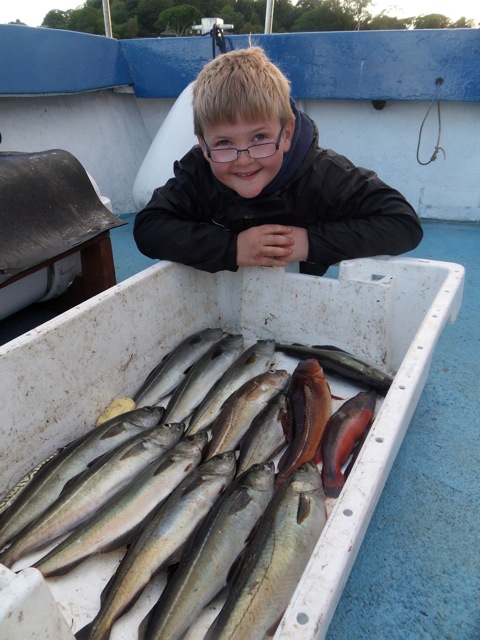
We were fortunate enough to get back out again yesterday, and what a haul! We brought home 40 fish - cod, pollack (lythe) and mostly coalfish (blockan) - of around 2lbs weight each. Also got a wrasse and a wheen o mackerel forbye. As you can see from the pics below we had nearly 3 full buckets, which when we got home again became a well-filled sink where all were gutted, beheaded, de-scaled, cleaned and readied for either the cooker or the freezer.
Even a generation or two ago, people around our area caught big numbers of fish during the summer months for survival - layered them in saut (salt) in big earthen crocks which were then stored in a cool outhouse - all to keep the family alive until springtime. We are fortunate to go fishing without that pressure, simply for leisure and enjoyment... and in good weather.
Visit the Peninsula Charters website here. And when you book them tell them I sent you!


Saturday, August 25, 2012
Old Crow Medicine Show clip of "Jim Jones at Botany Bay" (go to 2.36 - 3.28)
This is an old English / Australian folk song. In this clip Old Crow Medicine Show play it to the tune that Bob Dylan used to record the song in the 60s. It was originally published in 1907 in Charles MacAlister's book "Old Pioneering Days in the Sunny South" on page 72 where he says the tune is "Irish Molly-O" (online edition here). Here are the words of "Irish Molly-O", a tale of a Glasgow man called MacDonald who emigrates to Tyrone, falls in love with Molly, is set for America but Molly's father is having none of it. It is said to be from from around 1810:
IRISH MOLLY-O
Tell me who is that poor stranger that lately came to town
And like a pilgrim all alone, he wanders up and down
He's a poor forlorn Glasgow lad and if you'd like to know
His heart is breaking all in vain for Irish Molly-o
Chorus:
She is young and she is beautiful and her likes I've never known
The lily of old Ireland and the primrose of Tyrone
She's the lily of old Ireland and no matter where I go
My heart will always hunger for my Irish Molly-o
Oh but when her father heard of this a solemn vow he swore
That if she wed a foreigner, he would never see her more
He called for young MacDonald and he plainly told him so
I'll never give to such as you my Irish Molly-o
MacDonald heard the heavy news and sadly he did say
Farewell my lovely Molly, I am banished far away
Till death shall come to comfort me and to the grave I go
My heart will always hunger for my Irish Molly-0
Some of you will recognise the general format of the chorus. "Irish Molly - O" was adapted and became "The Hat My Father Wore"... but is best known as the Orange folk song "The Sash My Father Wore", which is another tale of travel between Glasgow and Ulster.
THE SASH
Here am I, a loyal Orangeman, from Ulster's shores I came
To see my Glasgow brethren of honour and of fame
And to tell them of my forefathers who fought in days of yore
All on the twelfth day of July in the Sash my father wore!
Chorus:
Sure it's old, and it is beautiful and its colours they are fine
It was worn at Derry, Aughrim, Enniskillen, and the Boyne.
Sure my father wore it when a youth in the bygone days of yore,
And it's on the Twelfth I love to wear The sash my father wore.
Amazing how something as simple as a tune can link Scotland, Ulster, America and Australia across the centuries, and can be both "Irish" and "Orange".
Thursday, August 23, 2012
Snobs' Law: Criminalising Football Fans in an Age of Intolerance
Many of my readers here (of whatever background) will recognise Dr Stuart Walton's conclusion in this article which is based upon his new book Snobs' Law: Criminalising Football Fans in an Age of Intolerance.This is his conclusion on the sectarian issue in Scotland today:
"...the rise of anti-sectarianism did not emerge because of a rise in sectarian behaviour, or of sectarian violence; yet anti-sectarianism became a significant political, media, policing and legal matter in Scotland. As we have seen, the rise of interest in sectarianism has absolutely nothing to do with the behaviour of people on the terraces or on the streets. It has, on the contrary, everything to do with the activities and rhetoric of the Scottish elites and their establishment of a virtual industry of anti-sectarianism..."
This really clicked with me today, based upon an experience yesterday where, at an event based upon local history, the media outlet that was present attempted to 'spin' the project into a quasi-sectarian issue. It was bizarre and bewildering.
Northern Ireland has its historic problems, but it also has a poisonous anti-sectarian industry (which paradoxically, by constantly raising the issue, has become pro-sectarian) which seeks to insert a narrative of social division into spheres of life where none exists. It is very sad to read that Scotland now has a sectarian industry too.
Hopefully (both in Scotland and here in NI) most people will continue to get along with each other despite this divilment.
Tuesday, August 21, 2012
The Assassination of Jesse James by the Coward Robert Ford
Thanks to Will Ghormley of Iowa for getting in touch and inadvertently reminding me of this 2007 movie. It's seriously underrated (probably because the leading man is Brad Pitt). The cinematography is wonderful.
Saturday, August 18, 2012

Friday, August 17, 2012
What's the connection between the Ulster Covenant and the 1949 Le Mans 24hr winning Ferrari team?...

Wednesday, August 15, 2012

Tuesday, August 07, 2012
Rev John Pollock (1852 - 1935): From Glasgow to Belfast, "Scotland for Christ", "Ireland for Christ" and the CE Covenant
The Rev John Pollock was born in Scotland in 1852 (reportedly Govan in Glasgow) and ministered in Fife, Edinburgh and Glasgow. He came to Belfast in 1901 to become minister of St Enoch's Presbyterian Church from 1901 until retirement in 1930, a successor to the renowned "Roaring" Hugh Hanna who had retired in 1891. Built in 1872, St Enoch's was said to be the biggest Presbyterian church in the British Isles, but today it is closed.
John Pollock was highly active within the "Christian Endeavour" youth movement and became the President of CE in Ireland, Britain and then Europe.
CE had been founded in the USA in 1881 by Francis E Clark. In 1889 a branch of CE was established at Agnes St Presbyterian Church in Belfast by a working class woman called Margaret Magill. The movement grew rapidly and by 1896 there were 100 CE societies in Protestant churches across Ireland (bringing together Presbyterian, Methodist, Moravian, Baptist, Congregational, Church of Ireland and Quaker) and by 1889 over 10,000 young people were members. It can be claimed that CE brought a unity of purpose and spirit of co-operation across the Protestant denominations in Ireland which had seldom, if ever, been seen before. Significantly, a Covenant was at the heart of its functions. As the 1977 book A History of the Christian Endeavour Movement in Ireland states -


"... The primary emphasis of Christian Endeavour has been on the response of the individual to the redeeming work of Jesus Christ, a response expressed in faith, commitment and service. This has been expressed through the covenant or pledge taken by each active member, and renewed each month at a special meeting of the society to which he or she belongs..."
The book gives three separate covenants as an appendix: the Active Members Covenant, the Junior Active Members Covenant and the Trial Members Covenant. So in late 1800s and early 1900s Ulster, Christian Endeavour - probably the first pan-denominational youth movement across all of the evangelical Protestant churches - was using a Covenant as its basis for membership.
In CE founder Francis Clark's 1906 book Christian Endeavor in All Lands, (click here for online edition), a 25-years-on retrospective, these two excerpts speak volumes:
'...think of the "Solemn League and Covenant" of the Scottish martyrs! There is no more holy spot than the flat tombstone in Greyfriars' churchyard in Edinburgh where with the blood drawn from their own veins they signed and sealed the covenant which ensured Scotland's liberties and made Scotland great...'
'...stimulated and sustained by the obligation of a covenant with God and men as binding and exalting as the "Solemn League and Covenant" of Scotland's noblest days...'
Back in 1896, when still a minister of a church in Scotland, John Pollock had written a hymn entitled "Scotland for Christ" for the Scottish National Christian Endeavour Union; I found it in an old hymn book last week. Typical of the era it is full of references to the old Scottish Covenanters of the 1600s: -
SCOTLAND FOR CHRIST
"Scotland for Christ" Hark the challenge resounding
High over mountain and valley and plain
All the dark forces of treason confounding
Christ is advancing to conquer and reign!
Chorus:
Rally Endeavourers! Swell out the chorus!
Trusting in God and renewing your tryst
Bright gleams the banner that's marching before us
Claiming the victory - "Scotland for Christ!"
Men of the Covenant! In glad attestation
Setting your seal to the bond of the Lord
Follow your fathers in high consecration
Filled with His Spirit, believing His word
Sons of the martyrs! be this your ambition
Moved by the purpose their memory inspires
Calmly confronting this world's opposition
Bravely to follow your patriot sires
Brothers and sisters in Christian endeavour
Loving and earnest, leal-hearted and true
Bound in a union that nothing can sever
Rally around the old Banner of Blue
"Scotland for Christ!" from the cot to the palace
"Scotland for Christ!" pass the watchword along
Till from her mountains, her glens and her valleys
Scotland united shall join in our song!
(words from Manly Praise - a Collection of Solos, Quartettes and Choruses edited by Rev Wm Nelson, 1897)
IRELAND FOR CHRIST
Pollock was asked to write a similar hymn, "Ireland for Christ", for the 1899 British Christian Endeavour Convention which was held in Belfast, attracting 1900 delegates, but I haven't located it as yet. Both pieces were said to "...have remarkable power, and are characteristic of the music of the two countries...". Here are some artefacts from early Belfast CE Conventions:

Pollock's son, Paul Gilchrist Pollock, was in the 14th Royal Irish Rifles and was killed on the 1st July at the Somme. There was a memorial plaque to him at St Enoch's Church (see image here / portrait available on this website). Another son was a Royal Navy officer, and Rev Pollock's daughter Elsie was a sister in the Ulster Volunteer Force hospital - after the Great War she became a missionary in Formosa (today Taiwan).

CE AND THE ULSTER COVENANT?
By 1907 CE membership in Ireland was still around 10,000 young people. It experienced a decline and by 1911 there were 6,000 members, but numbers surged again with missions held in Portadown and Belfast in 1911 - 1913. CE membership peaked in 1936 with nearly 15,000 members in Ireland and 452 local societies.
Rev John Pollock was an influential Glasgow-born Presbyterian, ministering in north Belfast to the biggest Presbyterian congregation in Britain, and a leading member of the global Christian Endeavour youth movement whose ethos is still today based upon a 'Covenant'. This is an intriguing example of how the idea of a "Covenant" was very much a familiar element within Ulster Protestant church culture in the decades before the eventual Ulster Covenant of September 1912, signed by 471,414 people exactly 100 years ago.
Christian Endeavour still exists and provides an excellent range of youth-oriented materials, resources and services to churches around the world including here at home.
• To find out more about the work of Christian Endeavour today, visit their website here.
• Their 98th Irish Convention takes place in September, click here for details.

Saturday, August 04, 2012
Fishing off the Mull of Galloway
Photo © Whitby Sea Anglers
We live just across the North Channel from the Mull of Galloway - over the years I've posted plenty of photos here of our view of the Mull on clear days. For a while now I've been reading up on sea angling techniques from the Whitby Sea Anglers' visits when they travel 300 miles north to fish the Mull. They've now put together a very informative article summarising the shoreline terrains and the species they've caught. You can read it here. There's an even more detailed website here of sea fishing on the Isle of Man.
My brother just spent 10 days in Waterford and Kerry, and he tells me that along the coast there the local council has helpfully put up interpretive signage showing the best spots for sea angling, and info on species / times of year / bait and tackle to use.
Back in 1683, William Montgomery wrote his Description of the Barony called The Ardes to his lifelong friend Patrick Savage of Portaferry. It's effectively the first "tourist trail" of the area. In it Montgomery said that the coast of the Ardes and Lecahill (Lecale) "...abounds with fishes, as herrings, in harvest, also codd, ling, mackerel, barins*, lythes, blockans, lobsters, crabbs, gray lords (which are near as big as codds), whiteing, haddocks, plaice and large dogg fish..."
You can still catch them all these days. A seafood banquet! Perhaps this is something that the local tourism authorities could (excuse the pun) get their teeth into.
* is this a mis-spelling of ballan wrasse?

Wednesday, August 01, 2012


Tuesday, July 31, 2012
Deep sea fishing with Peninsula Charters, Portaferry
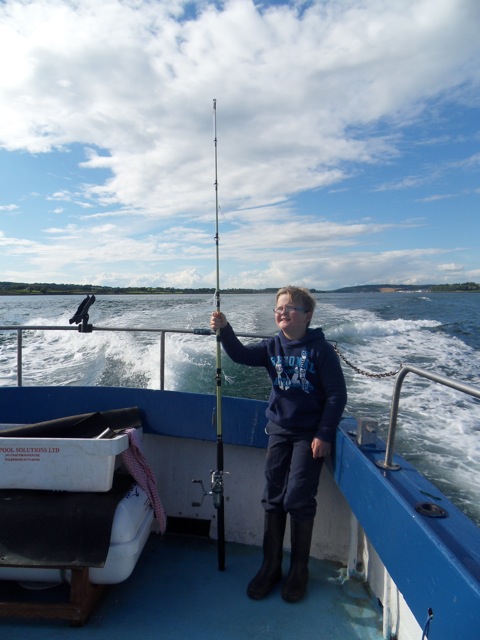
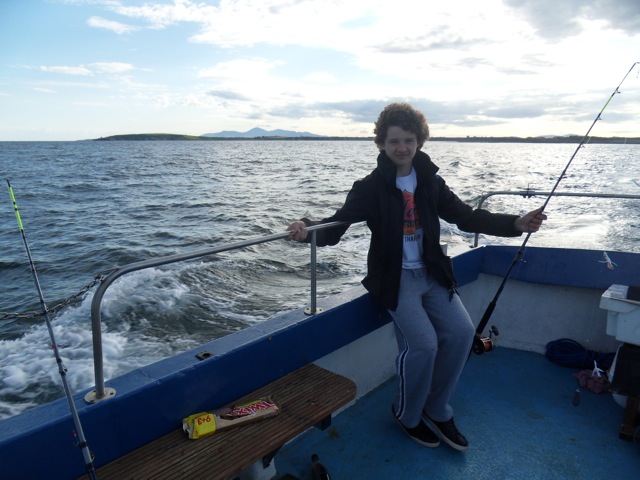
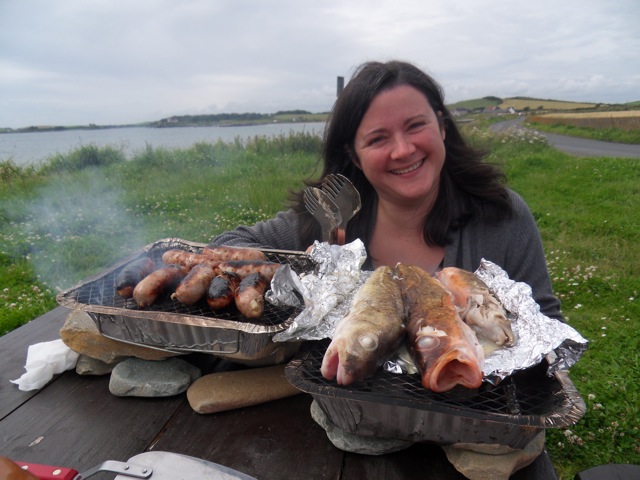
Last night the five of us went out fishing from Portaferry with Peninsula Charters on a 3 hour trip, from 5.30 till 8.30, taking advantage of the tide times. Those of you how know me well will know how much I love getting out onto the water, usually up around Bangor or Donaghadee. So we tried something different last night and boysadear did it pay off! Best night's fishing I can remember, and the family were amazed at the variety and quality of the catch. The freezer is well stocked now with pollock (lythe) and coalfish (blockan), we landed a few good cod which we barbecued earlier today and also some wrasse (but we only kept one of them as a trial - it was tasty, soft, but very bony). The men that run the boat have fished the bottom end of the Peninsula, Strangford Lough and the coast of Lecale all their lives and so when we got going the banter and oul stories were mighty.
Website is here. We are definitely planning a few more trips with them before the summer is out, so anyone who lives in the area who fancies coming with us during August please get in touch with me and I'll make the charter arrangements.
Otherwise feel free to contact them directly and prepare for a trip to remember!
Farewell Portaferry
First coalfish
With the Mourne Mountains behind
Nice coalfish for Charlie
The SeaGen tidal energy turbine
Homeward bound
Gutted, mostly beheaded...
...and battered fillets for supper!
Two cod and a wrasse heading for the barbecue
A happy chef!
You could spend a lot of money travelling to (for example) the west coast of Ireland or Scotland for an experience like this. Now it's available right on our own doorstep. Scenery, banter, stories, the satisfaction of catching your own dinner... and far more enjoyable (and sustainable) than queueing at the fish counter at Tesco! We just need to get a bigger freezer...





Friday, July 27, 2012
BBC2 tonight: The Great British Story - Episode Six: The Age of Revolution - 7.30pm
Thanks to William for this tip-off, the publicity information says:
"...This week Michael tells the story of the British Civil Wars, seen from the perspective of the people, right across the British Isles. In search of their experience he travels to Dublin to uncover the horrors of the Irish Rebellion, to County Down with the Ulster Scots, and to Cornwall where an amazing local project is mapping the battlefield finds of Parliament's greatest defeat.
Uncovering little known stories in the arms manufacturing centres of the Black Country and Birmingham, Michael shows how the war split local communities. In Myddle, in Shropshire, a unique village account gives a vivid portrait of the young men who died in the war. In the aftermath, with the monarchy overthrown and the king executed, revolutionary movements rise up, Levellers and Diggers, which Michael argues are the roots of our modern British democracy. The episode ends with the monarchy restored and the British people united under one crown, on the verge of the Age of Industry..."
It will be interesting to see how our story is told and portrayed. I was asked to take part in one of "The Great British Story" local events at Mount Stewart back in May but wasn't available to do so.
Link to BBC website here.

Tuesday, July 24, 2012
Seth Sykes (1892 - 1950) - unique artefacts discovered!
Some of you will know of Seth Sykes, a Glasgow tram conductor and evangelist. He and his wife Bessie travelled the British Isles and spent much time in Ulster during the 1930s and 1940s at places like the Shankill Road Mission and the various Christian Workers Union halls, especially the one in Lisburn which is still going today. I have met many folk here who met the Sykes and remember them fondly. The rare booklet "Seth Sykes - a Great Little Man" tells his life story and gives a number of accounts of Seth and Bessie's time on this side of the water.
One of their methods was to go to public places, like Market Square in Lisburn, where they used 'magic lantern' shows (glass slides beamed from an enormous projector) to project large images onto the exterior walls of public buildings or onto temporary screens - all to attract a crowd and to then present the Gospel message to them through pictures, stories and songs. And we think Powerpoint is innovative? Try getting an outdoor electrical supply in post-war Ulster!
Amazingly, a man contacted me a few weeks ago (thanks to finding previous blogs posts here which mentioned the Sykes') to say that he had just unwittingly obtained what turned out to be the Sykes' projector and glass slides collection at an auction in Yorkshire. I have now acquired them from the man and they should arrive with me later this week. More info to follow...
